Beyond International Aid: The Strategy of Local NGOs in Post-Disaster Community Economic Empowerment in Aceh
DOI:
https://doi.org/10.63924/joas.v4i1.281Keywords:
Community Empowerment, Forum Bangun Aceh, Post-Disaster Recovery, Local NGO, Alternative DevelopmentAbstract
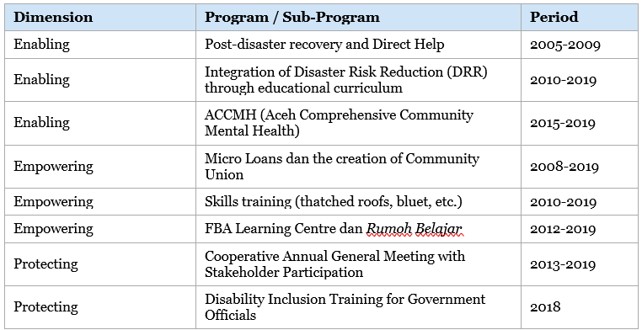
Following the 2004 Indian Ocean Tsunami, the scale of international aid that flowed into Aceh exposed a structural problem instead of solving one. Assistance concentrated in areas that were physically accessible, while many rural communities remained underserved, producing new inequalities rather than an even recovery. This gap opened space for local civil society organizations to take on roles that neither the state nor international agencies had filled. This study examines how Forum Bangun Aceh (FBA), a Banda Aceh based local NGO, strategized community empowerment through its Economic Empowerment program between 2005 and 2019. Using a qualitative case study approach built on systematic document analysis, the study applies Friedmann's (1992) three-dimensional empowerment framework, enabling, empowering, and protecting, to trace how FBA's programs evolved over fifteen years. The findings show that FBA's strategy coherently spans all three dimensions: enabling through post-disaster recovery and disaster risk reduction education, empowering through micro credit, cooperative formation, and skills training rooted in local economic practices, and protecting through multi-stakeholder engagement and advocacy for persons with psychosocial disabilities. These findings carry two implications. Theoretically, they support the argument that empowerment interventions anchored in local value systems tend to outlast those designed externally. Practically, they offer local NGOs and policymakers a working model for sequencing recovery, capacity building, and advocacy without relying on the scale of international actors.
References
Alkire, S. (2002). Dimensions of human development. World Development, 30(2), 181–205. https://doi.org/10.1016/S0305-750X(01)00109-7
BRR (Badan Rehabilitasi dan Rekonstruksi NAD-Nias). (2009). Aceh and Nias two years after the tsunami: The recovery experience. BRR NAD-Nias.
Chambers, R. (1994). The origins and practice of participatory rural appraisal. World Development, 22(10), 1437–1454. https://doi.org/10.1016/0305-750X(94)90161-9
Christens, B. D. (2012). Targeting empowerment in community development: A community psychology approach to enhancing local power and well-being. Community Development Journal, 47(4), 538–554. https://doi.org/10.1093/cdj/bsr045
Dushkova, D., & Ivlieva, O. (2024). Empowering communities to act for a change: A review of the community empowerment programs towards sustainability and resilience. Sustainability, 16(19), 8700. https://doi.org/10.3390/su16198700
Forum Bangun Aceh. (2019a). Disaster risk reduction. https://www.fba.or.id/disaster-risk-reduction.html
Forum Bangun Aceh. (2019b). Economic empowerment. https://www.fba.or.id/economic-empowerment.html
Forum Bangun Aceh. (2019c). FBA learning centre. https://www.fba.or.id/fba-learning-centre.html
Forum Bangun Aceh. (2019d). Mirna dari Gampong Pante Rawa Kec. Sukamakmur. https://www.fba.or.id/success-story.html
Forum Bangun Aceh. (2019e). Proyek AC-CMH. https://www.fba.or.id/proyek-ac-cmh.html
Forum Bangun Aceh. (2019f). RAT Koperasi Asy-Syifa. https://www.fba.or.id/economic-empowerment.html
Forum Bangun Aceh. (2019g). Who we are. https://www.fba.or.id/who-we-are.html
Friedmann, J. (1992). Empowerment: The politics of alternative development. Blackwell Publishers.
Hummel, D. J., & Kusumasari, B. (2024). Power dynamics and resource dependence: NGO-government collaboration in Yogyakarta, Indonesia. Public Administration and Development, 44(1), 32–42.
Irwandi. (2014, December 26). Irwandi: Ada kerancuan dalam distribusi bantuan [Irwandi: There is confusion in aid distribution]. CNN Indonesia. https://www.cnnindonesia.com/nasional/20141226144556-20-20626
Irwansyah, M., Nursaniah, C., Qadri, L., & Mariana, M. (2024). City of prone natural disasters: Mitigating post-tsunami on the coastal of Banda Aceh, Indonesia. Environmental Challenges, 15, 100925.
Kumi, E., Osei, D. B., & Tsiboe-Darko, A. (2025). Understanding local NGOs' sustainability in Ghana: Does organisational capacity and scope matter? Journal of Civil Society, 21(4), 387–407. https://doi.org/10.1080/17448689.2025.2547662
Noor, M. (2011). Pemberdayaan masyarakat. Jurnal Ilmiah CIVIS, 1(2), 87–99.
Smillie, I., & Minear, L. (2004). The charity of nations: Humanitarian action in a calculating world. Kumarian Press.
Sumiyana, Wivaqussaniyyah, Darwin, M., & Hadna, A. H. (2022). Partnership building between NGOs and Indonesian local governments: A case study of integrative leadership immersing itself in innovativeness. International Journal of Social Economics, 49(7), 1029–1048. https://doi.org/10.1108/IJSE-07-2021-0377
Suriastini, N. W., Wijayanti, I. Y., Sikoki, B., & Sumantri, C. S. (2023). Measuring disaster recovery: Lessons learned from early recovery in post-tsunami area of Aceh, Indonesia. Sustainability, 15(24), 16870. https://www.mdpi.com/2071-1050/15/24/16870
Telford, J., & Cosgrave, J. (2007). The international humanitarian system and the 2004 South Asian earthquake and tsunamis. Disasters, 31(1), 1–28. https://doi.org/10.1111/j.1467-7717.2007.00337.x
Townsend, J. G., Porter, G., & Mawdsley, E. (2004). Creating spaces of resistance: Development NGOs and their clients in Ghana, India and Mexico. Antipode, 36(5), 871–889. https://doi.org/10.1111/j.1467-8330.2004.00449.x
Yin, R. K. (2014). Case study research: Design and methods (5th ed.). SAGE Publications.
Published
How to Cite
Issue
Section
License
Copyright (c) 2026 Muhammad Asief Alizarzady

This work is licensed under a Creative Commons Attribution-ShareAlike 4.0 International License.