From Recognition to Implementation: An Analysis of the Aceh Government’s Policy on the Utilization of Hikayat Aceh Following Its UNESCO Memory of the World Inscription
DOI:
https://doi.org/10.63924/joas.v4i1.339Keywords:
Hikayat Aceh, Aceh Manuscripts, UNESCO Memory of the World, Cultural Policy, Policy ImplementationAbstract
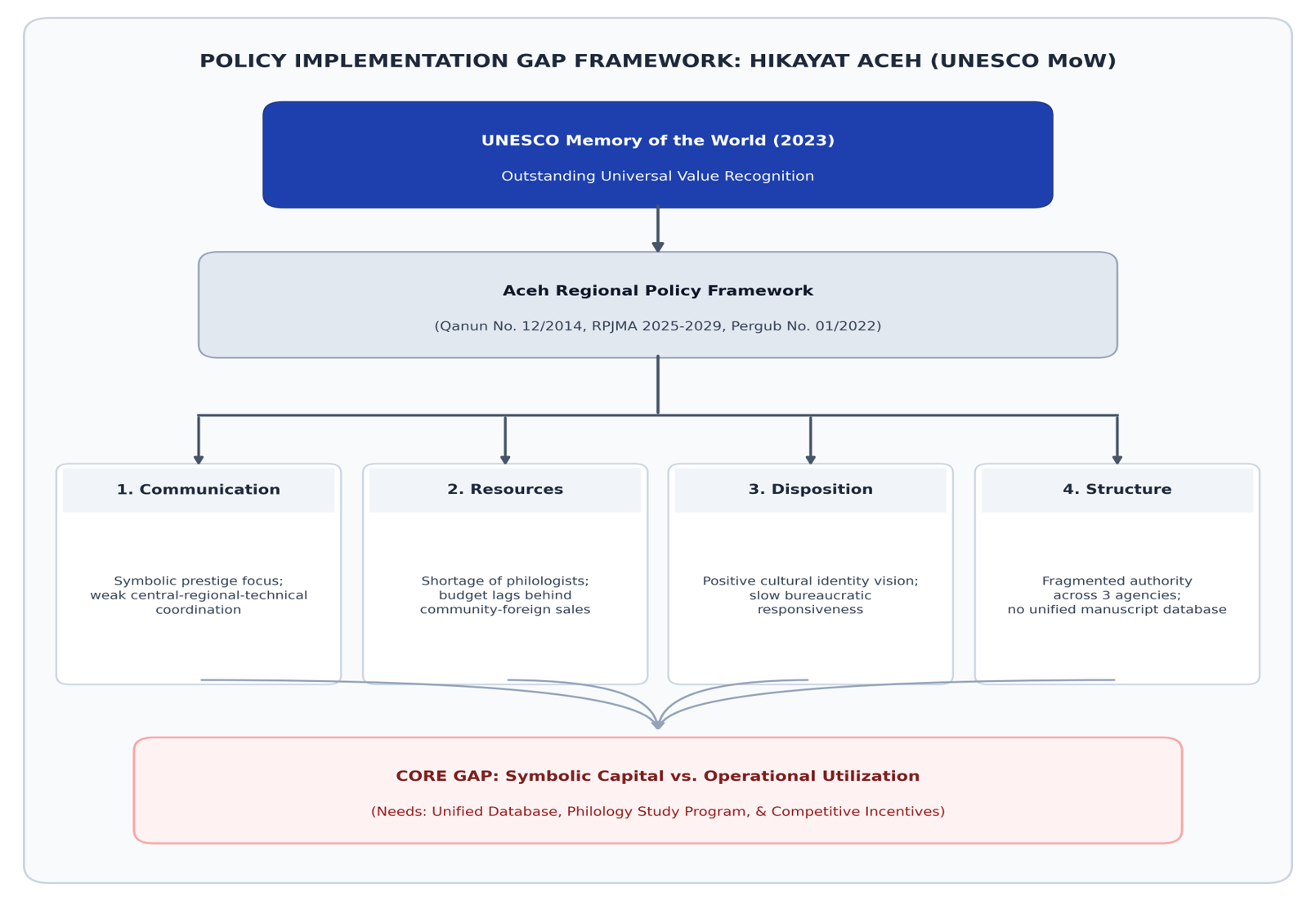
The inscription of the Hikayat Aceh onto UNESCO’s Memory of the World (MoW) Register in 2023 represented a pivotal milestone for safeguarding Aceh’s documentary heritage; nevertheless, whether this global designation has catalyzed concrete regional policy remains questionable. This study evaluates the Aceh Government's policy response to the MoW inscription, pinpointing the disconnect between international prestige and subnational execution. Employing a qualitative research design, we analyzed regulatory frameworks alongside medium-term development plans and conducted semi-structured interviews with five core stakeholder groups: a government administrator, a philologist, a university researcher, a manuscript repository manager, and a private museum director. Grounded in George C. Edwards III’s framework of policy implementation, our analysis reveals that the primary bottleneck stems not from a lack of formal regulations, but from a fundamental misalignment between UNESCO’s recognition and regional strategic priorities. Provincial policy continues to subsume manuscript stewardship under generic cultural preservation, failing to formulate targeted initiatives spanning education, interdisciplinary research, systematic digitization, and public access. Empirical accounts confirm that subnational intervention remains sluggish, severely constrained by chronic institutional deficiencies and a dearth of qualified philologists. Consequently, historical manuscripts remain vulnerable to illicit trade and foreign acquisition. We conclude that UNESCO recognition currently operates as little more than symbolic and ceremonial capital. Absent an integrated policy architecture bridging preservation with active utilization, this international accolade risks becoming functionally obsolete for Aceh’s broader knowledge ecosystem.
References
Aceh Online. (2026). Dampak banjir di Aceh: Ratusan manuskrip kuno rusak dan hilang [Impact of flooding in Aceh: Hundreds of ancient manuscripts damaged and lost]. Aceh Online.
Akil, M., & Sirajuddin, S. (2022). Cultural heritage preservation in regional Indonesia: Challenges and prospects. Journal of Cultural Policy, 18(2), 112–128.
American Psychological Association. (2020). Publication manual of the American Psychological Association (7th ed.). American Psychological Association.
Azizah, L., & Hamzah, N. (2022). Bustān al-Salāṭīn: Representation of Malay Islamic civilization (Aceh) in the 17th century. Journal of Islamic Civilization, 4(1), 24–37. https://doi.org/10.33086/jic.v4i1.2940
Bania, A. S., & Akob, B. (2025). Preserving the Jawi script in Aceh: Assessing literacy, cultural heritage, and modern paradigm challenges. Studies in English Language and Education, 12(1), 457–470. https://doi.org/10.24815/siele.v12i1.36629
Bowen, G. A. (2009). Document analysis as a qualitative research method. Qualitative Research Journal, 9(2), 27–40.
Creswell, J. W., & Creswell, J. D. (2023). Research design: Qualitative, quantitative, and mixed methods approaches (6th ed.). SAGE Publications.
Dalglish, S. L., Khalid, H., & McMahon, S. A. (2020). Document analysis in health policy analysis studies in low- and middle-income countries: A practical guide. Health Policy and Planning, 35(10), 1423–1431. https://doi.org/10.1093/heapol/czaa064
Dinas Kebudayaan dan Pariwisata Aceh. (2018). Pokok Pikiran Kebudayaan Daerah (PPKD) Provinsi Aceh [Basic Concept of Regional Culture of Aceh Province]. Pemerintah Aceh.
Dippon, P., & Helferich, A. (2023). Sharing the documentary heritage of humanity: Disparities in distribution. International Journal of Heritage Studies, 29(3), 1–22. https://doi.org/10.1080/13527258.2023.2176347
Edmondson, R. (2002). Memory of the world: General guidelines to safeguard documentary heritage. UNESCO.
Edwards, G. C., III. (1980). Implementing public policy. Congressional Quarterly Press.
Fakhriati, F., Kalsum, N. U., Sugiarti, S., & Ilyas, H. F. (2022b). Carelessness in preserving manuscripts as a heritage: Cases of local treatment in Indonesia. Journal of Cultural Heritage Management and Sustainable Development. https://doi.org/10.1108/JCHMSD-01-2022-0008
Fakhriati, F., Mu’jizah, M., Holil, M., & Permadi, T. (2022a). Don’t leave Indonesian manuscripts in danger: An analysis of digitalization and preservation. Preservation, Digital Technology & Culture, 51(1), 3–15. https://doi.org/10.1515/pdtc-2021-0017
Hermansyah. (2012). Preservation of ancient Acehnese manuscripts before and after the 2004 Aceh earthquake-tsunami [Conference paper]. UiTM–IAIN Ar-Raniry International Seminar, Banda Aceh, Indonesia.
Hermansyah. (2025). The digitalization process of manuscripts as preservation and salvage of Islamic historical information sources in Aceh. Journal of Archival Science, 14(1), 45–62.
Holsti, O. R. (1969). Content analysis for the social sciences and humanities. Addison-Wesley.
Humaeni, A., & Sulaeman, S. (2021). Local government policy in preserving religious manuscripts in Banten. Journal of Indonesian Islam, 15(2), 311–334. https://doi.org/10.15642/JIIS.2021.15.2.311-334
Ifdhal, M. (2017, October 11). Peneliti: 200 manuskrip Aceh dijual ke luar negeri [Researchers: 200 Aceh manuscripts sold abroad]. ANTARA News.
Iskandar, T. (2001). Hikayat Aceh. Yayasan Karyawan.
Kalsum, N. U., & Rachmadini, N. (2023). The threat of discontinuity ancient scripts in the Islamic-Malay manuscript. Arabiyatuna: Jurnal Bahasa Arab, 7(1), 363–388. https://doi.org/10.29240/jba.v7i1.7327
Krippendorff, K. (2022). Content analysis: An introduction to its methodology (5th ed.). SAGE Publications.
Liaw, Y. F. (2011). Sejarah kesusastraan Melayu klasik [History of classical Malay literature]. Yayasan Pustaka Obor Indonesia.
Moleong, L. J. (2021). Metodologi penelitian kualitatif [Qualitative research methodology] (Ed. Rev.). PT Remaja Rosdakarya.
Mubarok, S., Zauhar, S., Setyowati, E., & Suryadi, S. (2020). Policy implementation analysis: Exploration of George Edward III, Marilee S Grindle, and Mazmanian and Sabatier theories in the policy analysis triangle framework. Journal of Public Administration Studies, 5(1), 33–38.
Pemerintah Aceh. (2014). Qanun Aceh No. 12 Tahun 2014 tentang Kebudayaan Aceh [Aceh Qanun No. 12 of 2014 on Aceh Culture]. Pemerintah Aceh.
Pemerintah Aceh. (2022). Peraturan Gubernur Aceh No. 01 Tahun 2022 tentang Kurikulum Muatan Lokal Aceh [Aceh Governor Regulation No. 01 of 2022 on the Aceh Local-Content Curriculum]. Pemerintah Aceh.
Pemerintah Aceh. (2025). Rencana Pembangunan Jangka Menengah Aceh (RPJMA) 2025–2029 [Aceh Medium-Term Development Plan 2025–2029]. Pemerintah Aceh.
Rahman, N. (2019). I La Galigo: Pengakuan UNESCO dan penguatan kebudayaan Sulawesi Selatan [I La Galigo: UNESCO recognition and the strengthening of South Sulawesi culture]. Pusat Kajian La Galigo.
Saputra, R. (2024). Governance frameworks and cultural preservation in Indonesia: Balancing policy and heritage. Journal of Ethnic and Cultural Studies, 11(3), 25–50. https://doi.org/10.29333/ejecs/2145
Srimulyani, E., & Amalia, R. (2023). Local content curriculum and cultural identity transmission in Acehnese schools. Indonesian Journal of Islam and Muslim Societies, 13(1), 89–114. https://doi.org/10.18326/ijims.v13i1.89-114
Sukmawati, S., & Suryani, I. (2024). Preservation of ancient manuscripts in university libraries: A comparative study. Library Philosophy and Practice, 2024, 1–18.
UNESCO. (2015). Recommendation concerning the preservation of, and access to, documentary heritage including in digital form. UNESCO.
UNESCO. (2021). Memory of the world: General guidelines. UNESCO.
UNESCO. (2023). The Hikayat Aceh: Three manuscripts on life in Aceh, Indonesia, in the 15th–17th century. Memory of the World Register. UNESCO.
Yusof, M. M., & Ismail, R. (2022). Heritage manuscript acquisition and economic incentives: Policy perspectives from Southeast Asia. Heritage Science, 10(1), 78–92. https://doi.org/10.1186/s40494-022-00712-4
Zed, M. (2021). Metode penelitian kepustakaan [Library research method] (Ed. 4). Yayasan Pustaka Obor Indonesia.
Published
How to Cite
Issue
Section
License
Copyright (c) 2026 Iswandi Iswandi, Hermansyah Hermansyah, Putra Hidayatullah

This work is licensed under a Creative Commons Attribution-ShareAlike 4.0 International License.