Stylistics of Moral Resilience: Recontextualizing Oral Poetry for Youth Character Education in Aceh Society
DOI:
https://doi.org/10.63924/joas.v3i2.141Keywords:
Aceh society, Pedagogical stylistics, Pantun nasihat, Moral resilience, Ethno-pedagogyAbstract
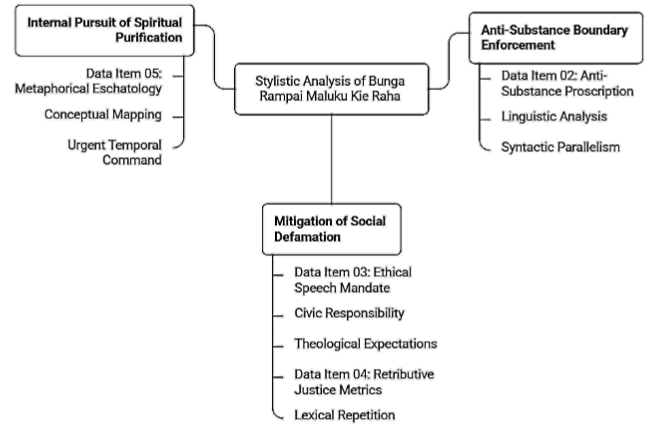
This study addresses the destabilization of moral frameworks among youth in contemporary Islamic societies, a phenomenon accelerated by rapid digitization. We investigate how the structural and stylistic mechanisms of traditional oral poetry can serve as pedagogical instruments to build ethical resilience among Gen Z and millennial cohorts in modern Aceh. Methodologically, the inquiry adopts a qualitative descriptive design grounded in pedagogical stylistics to conduct a close textual analysis of twenty purposively sampled advice quatrains from the Bunga Rampai Maluku Kie Raha anthology. Our analytical framework evaluates these texts across specific operational metrics: phonology, syntax, and conceptual metaphor. The empirical results reveal that the rigid structural blueprint of the quatrain, particularly the architectural division between the foreshadowing lines (sampiran) and the semantic core (isi), functions as an efficient cognitive delivery system that optimizes mnemonic retention. Additionally, the deliberate deployment of high-impact lexical markers combined with abrupt interrogative rhetorical shifts elevates generic ethical advice into absolute behavioral boundaries. These boundaries directly reinforce Acehnese socio-legal norms. Consequently, curriculum designers and language educators in Aceh can leverage trans-regional oral literatures to diversify character education frameworks, offering a vital alternative as localized oral traditions fade from daily usage. Ultimately, this research demonstrates that UNESCO-recognized traditional poetic structures operate not merely as historical artifacts, but as dynamic socio-pedagogical interventions capable of maintaining ethical stability during acute cultural transitions.
References
Badaruddin, B., Yusuf, Y. Q., & Syafrizal, S. (2021). Exploring ethnopoetics in Indonesian oral traditions: A stylistic analysis of traditional rhymes in moral pedagogy. International Journal of Society, Culture and Language, 9(2), 143–156.
Bania, A. S. (2026). Developing the use of Google Translate to enhance student’s ability to comprehend Acehnese oral traditions. LINGPOET: Journal of Linguistics and Literary Research, 7(2), 129–139.
Bennett, A. (2021). Youth culture and the digital age: Resistance, compliance, and identity. British Journal of Sociology, 72(3), 450–465.
Beri, S. (2022). Decolonizing oral traditions: Indigenous poetics in the modern landscape. Journal of Cultural Heritage, 54, 112–120.
Derks, W. (2022). The UNESCO inscription of Pantun: Cultural heritage, shared memory, and the politics of identity in the Malay world. Wacana, Journal of the Humanities of Indonesia, 23(2), 341–367. https://doi.org/10.17510/wacana.v23i2.1025
Fabb, N. (2024). The metrical structure of oral poetry. Cambridge University Press.
Fitri, N. (2025). Pedagogical stylistics: Teaching morality through traditional rhyme formats in contemporary Indonesia. Language and Education, 39(1), 45–62.
Gibbons, J., & Whiteley, S. (2021). Contemporary stylistics: Language, cognition, interpretation. Edinburgh University Press.
Harris, R. (2021). Subcultural resistance in contemporary poetics. Oxford University Press.
Harun, M., Ramli, R., & Jalil, A. (2024). Islamic values in the maritime Southeast Asian oral tradition: A comparative analysis of Pantun Nasihat and regional didactic poetry. Jurnal Islam dan Masyarakat Kontemporari, 15(1), 89–104. https://doi.org/10.37231/jimk.2024.15.1.821
Hasan, M. (2023). Post-colonial linguistic resistance: Reclaiming the Bunga Rampai poetics. Southeast Asian Review, 51(3), 201–219.
Healy, M., & Thomas, G. (2023). Moral panic or moral deficit? Youth behavior and the disruption of educational norms. Journal of Youth Studies, 26(4), 512–529.
Kim, J., & Lim, H. (2023). Educational moral crises in post-pandemic spaces: A global review. Educational Philosophy and Theory, 55(8), 899–911.
Lambrou, M. (2022). Contemporary stylistics and language use. Bloomsbury Academic.
Mullany, L. (2023). Sociolinguistics and stylistic variation. Palgrave Macmillan.
Nasrianti, N., Sanusi, S., & Ilyas, I. (2025). Legal protection of traditional cultural expressions in Aceh: A comparative legal analysis of Islamic law and positive law in Indonesia. Al-Istinbath: Jurnal Hukum Islam, 10(1), 45–62.
Pradopo, S. (2021). Traditional poetics and modern classrooms: Recontextualizing Indonesian pantun. Journal of Southeast Asian Studies, 52(2), 302–321.
Pratama, A. (2026). Digital interventions in oral literatures: Millennials, Gen Z, and the survival of the pantun. Cultural Trends, 35(2), 118–135.
Rahman, A., & Salleh, M. (2022). Pantun as cognitive metaphor: Preserving Malay moral epistemology in the 21st century. Asian Ethnology, 81(1), 143–165.
Rahman, A., & Yusuf, M. (2025). Adapting oral traditions into Islamic moral education: Hadih Maja and Pantun as dynamic pedagogical tools in contemporary Aceh. Jurnal Pendidikan Islam, 11(1), 12–29. https://doi.org/10.14421/jpi.2025.111-02
Rahmawati, P. (2021). The revitalization of Islamic parenting values in Hadih Maja Aceh. At-Tarbiyat: Jurnal Pendidikan Islam, 4(3), 312–325. https://doi.org/10.37758/jat.v4i3.312
Raja, P., Setiyadi, A. B., & Sukirlan, M. (2023). The cognitive processing of the ABAB rhyme scheme in Pantun: Memory retention and pedagogical implications for young learners. Asian-Pacific Journal of Second and Foreign Language Education, 8(1), 45–58. https://doi.org/10.1186/s40862-023-00192-w
Saad, S., Mansor, N. S., Amat, R., Subri, S., & Din, M. M. M. (2025). Reviving oral traditions: Digital preservation of Asian indigenous folktales through the Nusantara E-Book. Pertanika Journal of Social Sciences and Humanities, 33(4), 57–61.
Saldana, J. (2022). Ethics and ethno-pedagogies: Reclaiming moral value through folklore. International Journal of Qualitative Studies in Education, 35(7), 789–804.
Setiawan, B., & Wijaya, H. (2022). The stylistics of resistance in Indonesian regional poetry anthologies. Wacana: Journal of the Humanities of Indonesia, 23(2), 341–366.
Simpson, P. (2021). Stylistics: A resource book for students. Routledge.
Stockwell, P. (2020). Cognitive poetics: An introduction. Routledge.
Sumanto, S. (2018). A sociological analysis of Islamic law on the relationship between adat law, ethics, and social change in Indonesia. Legal Journal Review, 2(1), 88–97.
Turco, L. (2020). The book of forms: A handbook of poetics. University Press of New England.
Vromen, A. (2022). Digital citizenship and youth resistance networks. Palgrave Macmillan.
Ward, K., & Marwick, A. (2024). Gossip, digital panopticons, and youth morality. Media, Culture & Society, 46(2), 231–248.
Yusuf, Y. Q., & Yusuf, Q. (2020). Preserving local wisdom and religious identity through traditional literature in Aceh. Al-Shajarah: Journal of Islamic Thought and Civilization of the International Islamic University Malaysia (IIUM), 25(2), 273–295.
Zain, M., & Yusof, N. (2023). UNESCO’s inscription of pantun: Regional identity and pedagogical revitalization. International Journal of Heritage Studies, 29(5), 411–427.
Zulhelmi, A. (2026). Digitalization of Hadih Maja as an effort to preserve Acehnese oral tradition: A structural and aesthetic analysis based on Roland Barthes’ semiotics. International Journal of Islamic History and Culture, 3(1), 45–58.
Published
How to Cite
Issue
Section
License
Copyright (c) 2026 Monica Monalisa Hutabarat, Rosmawaty Harahap

This work is licensed under a Creative Commons Attribution-ShareAlike 4.0 International License.