Social and Linguistic Adaptation among Aceh Singkil Students in Banda Aceh: Negotiating Kalak Kampong Identity
DOI:
https://doi.org/10.63924/joas.v3i2.277Keywords:
Kalak Kampong, Cultural Identity, Student Mobility, Linguistic Adaptation, Aceh SingkilAbstract
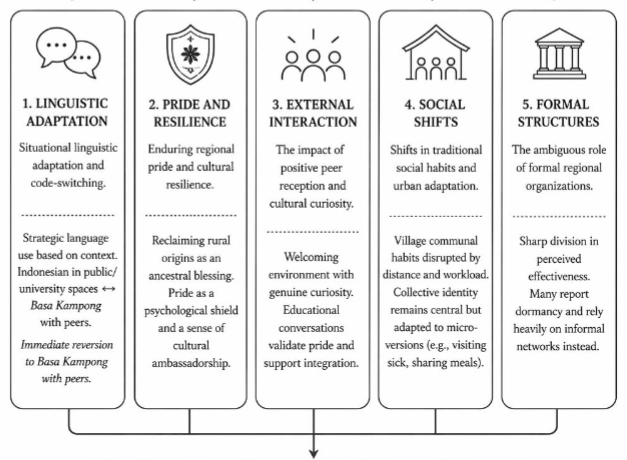
Background: Aceh Singkil students migrating to Banda Aceh for higher education enter a highly diverse, multi-ethnic urban campus environment. As an ethnic minority, these students face significant social and linguistic pressures to adapt to the dominant cultural norms, risking the loss of their distinct “Kalak Kampong” (village resident) identity and native language. Objective: This study investigates how Aceh Singkil diaspora students negotiate and maintain their Kalak Kampong cultural identity while dealing with these adaptation pressures in Banda Aceh. Methodology: Using a qualitative descriptive approach, primary data was collected through in-depth interviews with 10 Aceh Singkil students enrolled in various universities. The transcripts were analyzed utilizing the Miles and Huberman interactive model, consisting of data reduction, data display, and conclusion verification. Key Findings: The findings reveal that students actively employ strategic code-switching and bicultural integration. They utilize the Indonesian language and modify their social behavior for interethnic communication to ensure academic and social integration. Simultaneously, they strictly preserve the Singkil language and core communal values during intra-group interactions to maintain hometown solidarity. Furthermore, students maintained strong cultural pride and benefited from a welcoming campus environment that fostered curiosity rather than prejudice. Implications: The study demonstrates that internal provincial student mobility does not inherently erase minority identities. The practical implications highlight the need for university administrators to design inclusive campus policies and revitalize formal regional student organizations to actively support cultural diversity and bicultural resilience in modern educational hubs.
References
Al-Auwal, T. M. R., Amery, R., & Green, I. (2024). Language shift in Aceh: The sociolinguistic situation of post-conflict society. Studies in English Language and Education, 11(3), 1748–1766. https://doi.org/10.24815/siele.v11i3.39159
Al-Fairusy, M., & Abdullah, I. (2020). “Enda Kalak Singkel” Strengthening Consciousness of Community Identity of Aceh’s Border; Ethnic Contestation And Religion in Singkil. Jurnal Ilmiah Islam Futura, 20(2), 196. https://doi.org/10.22373/jiif.v0i0.6862
Al-Fairusy, M., Rohana, S., Kurniawan, C. S., Hemay, I., & Budiman, Z. (2024). Community Identity and Resilience as a Psychological Response to Converts on the Aceh Border. International Journal of Islamic Educational Psychology, 5(1). https://doi.org/10.18196/ijiep.v5i1.2071
Anisa Andiana W.S, Lisa Roselawati, Dinda Putri Maharani, & Ajeng Cahya Safitri. (2025). Sekolah Adat sebagai Basis Politik Identitas : Refleksi Identitas Sosial Pemuda Osing di Banyuwangi. Semantik : Jurnal Riset Ilmu Pendidikan, Bahasa Dan Budaya, 3(3), 287–297. https://doi.org/10.61132/semantik.v3i3.1967
Ash-Shiddiqi, H., Wahyuni Sinaga, R., & Audina, N. C. (2025). Kajian Teoritis: Analisis Data Kualitatif. Edukatif, 3(2), 333–343. https://doi.org/10.65311/je.v3i2.1628
Azarian, R. (2023). Social construction of places as meaningful objects: a symbolic interactionist approach. International Review of Sociology, 33(3), 546–564. https://doi.org/10.1080/03906701.2023.2259060
Berry, J. W. (2005). Acculturation: Living successfully in two cultures. International Journal of Intercultural Relations, 29(6), 697–712. https://doi.org/10.1016/j.ijintrel.2005.07.013
Demak, I. P. K., Prins, J., Meity, N., Bouwkamp‐Timmer, T., Fleer, J., & de Carvalho‐Filho, M. A. (2025). Under the radar: How participating in a student organization can shape medical students’ professional identity. Medical Education, 59(7), 704–718. https://doi.org/10.1111/medu.15609
Devianty, R. (2017). Bahasa Sebagai Cermin Kebudayaan. Jurnal Tarbiyah, 24(226–245). https://jurnaltarbiyah.uinsu.ac.id/index.php/tarbiyah/article/view/167/211
Enti Agestia, Desy Safitri, & Sujarwo Sujarwo. (2024). Adaptasi Mahasiswa Dalam Mengatasi Culture Shock Dalam Perkuliahan. RISOMA : Jurnal Riset Sosial Humaniora Dan Pendidikan, 2(4), 253–264. https://doi.org/10.62383/risoma.v2i4.180
Gallois, C., & Giles, H. (2015). Communication Accommodation Theory. In The International Encyclopedia of Language and Social Interaction (pp. 1–18). Wiley. https://doi.org/10.1002/9781118611463.wbielsi066
Grossman, J. (2019). Toward a definition of diaspora. Ethnic and Racial Studies, 42(8), 1263–1282. https://doi.org/10.1080/01419870.2018.1550261
Hikmah, L., & Suharno, S. (2022). Students multicultural awareness of Aceh dormitory in Yogyakarta. Jurnal Civics: Media Kajian Kewarganegaraan, 19(1), 143–153. https://doi.org/10.21831/jc.v19i1.40371
Kamaruddin, K., Fasya, T. K., Fazil, M., Cut, A., & Rusdi, B. (2021). Mencari Identitas Bersama (Studi Komunikasi Lintas Budaya Antara Suku Pakpak dan Suku Singkil di Kabupaten Aceh Singkil). Jurnal Jurnalisme, 10(1), 51. https://doi.org/10.29103/jj.v10i1.4888
Lubis, R., & Murhayati, S. (2025). Karakteristik Penelitian Kualitatif: Tujuan dan Manfaat Penelitian Kualitatif. Jurnal Pendidikan Tambusai, 9(2), 13066–13073. https://doi.org/https://doi.org/10.31004/jptam.v9i2.27044
Melia, Y., & Mesra, R. (2025). Transformasi Nilai-Nilai Budaya dan Identitas Sosial di Era Globalisasi: Perspektif Sosiologis. COMTE: Journal of Sociology Research and Education, 1(6), 268–276. https://doi.org/10.64924/09z86417
Muhammad Naufal, & Rini Rinawati. (2025). Adaptasi Budaya Mahasiswa Aceh di Bandung. Bandung Conference Series: Public Relations, 5(2). https://doi.org/10.29313/bcspr.v5i2.20204
Nabila, A. (2020). Banda Aceh Sebagai Kota Referensi Pendidikan. Kota Banda Aceh. https://dpmg.bandaacehkota.go.id/2020/10/28/banda-aceh-sebagai-kota-referensi-pendidikan/
Nurrisa, F., Hermina, D., & Norlaila. (2025). Pendekatan Kualitatif dalam Penelitian: Strategi, Tahapan, dan Analisis Data. Jurnal Teknologi Pendidikan Dan Pembelajaran, 2(3), 793-800. https://jurnal.kopusindo.com/index.php/jtpp/article/view/581
Nyamekye, E., Anani, G., & Kuttin, G. (2023). Language Choice and Identity Construction among Bilinguals at the University of Cape Coast, Ghana. Language Matters, 54(1), 3–20. https://doi.org/10.1080/10228195.2023.2188244
Pohan, Z. R. H. (2025). Kalak Kampong: Identitas dari Kesadaran Kelas dan Inferioritas di Aceh Singkil-Subulussalam. Abdurrauf Social Science, 2(1), 97–109. https://doi.org/10.70742/arsos.v2i1.69
Prasanti, D. (2018). Penggunaan Media Komunikasi Bagi Remaja Perempuan Dalam Pencarian Informasi Kesehatan. LONTAR: Jurnal Ilmu Komunikasi, 6(1). https://doi.org/10.30656/lontar.v6i1.645
Rahmadi. (2011). Pengantar Metodologi Penelitian. Antasari Press.
Safran, W. (1991). Diasporas in Modern Societies: Myths of Homeland and Return. Diaspora: A Journal of Transnational Studies, 1(1), 83–99. https://doi.org/10.3138/diaspora.1.1.83
Santoso, B. (2006). Bahasa dan Identitas Budaya. Sabda: Jurnal Kajian Kebudayaan, 1(1), 44–49. https://ejournal.undip.ac.id/index.php/sabda/article/view/13266
Suhery, D., Rangkuti, R., & Idami, Z. (2022). Language attitude of Singkil students in the context of bilingualism: a study of sociolinguistics. Journal of Applied Studies in Language, 6(1), 108–117. https://doi.org/10.31940/jasl.v6i1.348
Suryandari, N., Rahmawati, F. N., Kurniasari, N. D., Poernamasari, N., & Rakhmawati, Y. (2025). Identity negotiation in student cross cultural communication in Madura: A semio pragmatic approach in multiethnic social space. Bricolage : Jurnal Magister Ilmu Komunikasi, 11(2), 249. https://doi.org/10.30813/bricolage.v11i2.8485
Tajfel, H., & Turner, J. C. (2004). The Social Identity Theory of Intergroup Behavior. In Political Psychology (pp. 276–293). Psychology Press. https://doi.org/10.4324/9780203505984-16
Tanjung, M., & Pardede, L. (2019). Analisa Eksistensi Pengembangan Pendidikan dan Pelatihan Pegawai terhadap Produktivitas Kerja pada Dinas Perhubungan Komunikasi dan Informatika Tapanuli Tengah. Jesya (Jurnal Ekonomi & Ekonomi Syariah), 2(1), 210–223. https://doi.org/10.36778/jesya.v2i1.61
Thalal, M., Ibrahim, H., Muslem, A., Hasan, E., Jamil, T. M., & Yusuf, Y. (2026). Buried but unforgotten: nested-contentious memory of the 1955 Pulot-Cot Jeumpa massacre in Aceh, Indonesia. Frontiers in Political Science, 7. https://doi.org/10.3389/fpos.2025.1682124
Zuhrah, F., Sugiyarto, W., Marpuah, M., Khalikin, A., & Fauzah, T. I. (2025). Tradition Beyond Formal Fiqh: Ethnic Perspectives on Negotiating Kafāʾah in Marriage within the Aceh Singkil Community. Journal of Islamic Law, 6(2), 155–176. https://doi.org/10.24260/jil.v6i2.4187
Published
How to Cite
Issue
Section
License
Copyright (c) 2026 Anisya Adelia Ramadhana, Muhammad Thalal, Muhammad Yunus Ahmad

This work is licensed under a Creative Commons Attribution-ShareAlike 4.0 International License.