Bridging the EdTech Divide Under Resource Constraints: How a Rural Principal Navigated Resource Scarcity to Elevate Learning Quality
DOI:
https://doi.org/10.63924/jsid.v8i1.354Keywords:
Digital Leadership, Educational Technology, Principal Innovation, Resource-Constrained Schools, Rural Primary EducationAbstract
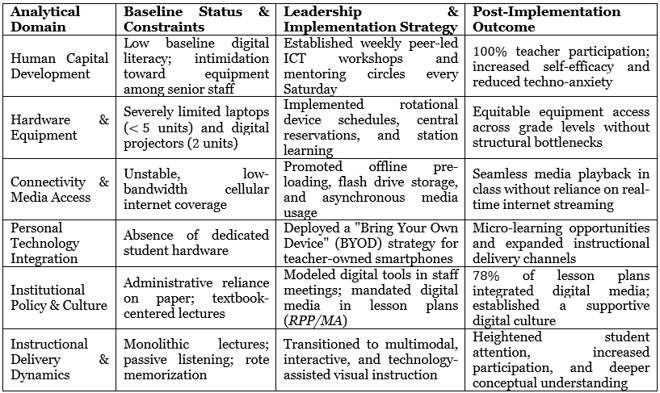
The global expansion of educational technology has highlighted a stark disparity in digital transformation between urban and rural schooling systems. In marginalized primary schools, severe infrastructure deficits and limited teacher digital literacy frequently impede meaningful EdTech integration. This qualitative single-case study investigated how a primary school principal conceptualized and enacted innovative leadership strategies to optimize technology-assisted learning within a resource-constrained rural context (SDN Satap 12 Konawe Selatan, Indonesia). Data was collected over an eight-week field engagement through semi-structured interviews, direct classroom observations, and documentary analysis involving the school principal, teaching staff, elementary students, and administrative personnel. Utilizing an interactive thematic analysis framework, the study revealed that principal leadership innovation operated across four interconnected dimensions: localized peer-mentoring circles, adaptive rotational hardware management, offline content pre-loading, and administrative tool modeling. Despite severe hardware shortages and unstable internet connectivity, these frugal leadership practices successfully enhanced teacher digital self-efficacy, expanded pedagogical diversity, and elevated student learning engagement. The study contributes a grounded model of "frugal digital leadership" to educational management literature, demonstrating that administrative vision and cultural empowerment can effectively offset material scarcity. These findings imply that educational policymakers should prioritize contextualized leadership capacity building and offline EdTech management strategies over top-heavy hardware distribution alone when driving digital equity in rural schools.
References
Abubakar, A., & Aspin, A. (2025). Peran kepemimpinan berbasis AI dalam meningkatkan pembelajaran sains pada siswa kelas rendah: Studi kasus di SDN 2 Lebo. Jurnal Obsesi: Jurnal Pendidikan Anak Usia Dini, 9(2), 623–634.
Arlinwibowo, J., Retnawati, H., & Kartowagiran, B. (2022). The impact of ICT on learning outcomes: A meta-analysis. International Journal of Evaluation and Research in Education, 11(2), 844–853.
Caratiquit, K., & Javier, B. (2025). Teachers' ICT competence and techno-efficacy in rural education settings. Participatory Educational Research, 12(3), 31–45.
Ghavifekr, S., & Yue, W. S. (2022). Technology leadership in Malaysian schools: Infrastructure vs. pedagogical practices. International Journal of Asian Business and Information Management, 13(1), 1–15.
Hasanah, S. N. A., & Yaqin, M. A. (2025). Principal strategies to improve teachers' pedagogic competence in the digital era. Journal of Educational Management Research, 4(1), 755–768.
Luo, H., Sun, D., Zhang, L., & Liu, Q. (2024). Elevating teachers' professional digital competence: Synergies of principals' instructional e-supervision, technology leadership and digital culture for educational excellence in digital-savvy era. Education Sciences, 14(3), 266.
Rasdiana, R., Nurhadi, T., & Akbar, M. I. (2024). The effect of digital leadership in nurturing teachers' innovation skills for sustainable technology integration mediated by professional learning communities. Journal of Infrastructure, Policy and Development, 8(10), 8480.
Schmitz, M.-L., Antonietti, C., Consoli, T., Cattaneo, A., Gonon, P., & Petko, D. (2023). Transformational leadership for technology integration in schools: Empowering teachers to use technology in a more demanding way. Computers & Education, 204, 104880.
Sunu, G. K. A. (2022). The impact of digital leadership on teachers’ acceptance and use of digital technologies. Mimbar Ilmu, 27(2), 283–291.
Widodo, H., Munjin, M., Sumiarti, S., & Wiyani, N. A. (2024). Indonesian school principals' strategic leadership in implementing 21st-century learning. International Journal for Multidisciplinary Research, 6(6), 30364.
Zeng, M., Cheah, K. S. L., & Abdullah, Z. (2025). Digital leadership and AI integration in resource-constrained schools. Frontiers in Education, 10, 1655967.
Published
How to Cite
Issue
Section
License
Copyright (c) 2026 Firman Firman, Ishak Bagea, Aspin Aspin, Abubakar Abubakar, Feni Febrianti

This work is licensed under a Creative Commons Attribution-ShareAlike 4.0 International License.
Most read articles by the same author(s)
- Feni Febrianti, Muh Ainul Basyirah, Implementing Learning-Based Models to Enhance Reading Comprehension Skills in Elementary School Students , Journal of Society Innovation and Development: Vol. 4 No. 1 (2022): JSID: November 2022
- Feni Febrianti, Anisa Ainul Mardiah, May Yati, Badrun Islma, Siti Julaika, Culturally Responsive Pedagogy in Primary Education: Leveraging Bima Local Wisdom to Foster Student Learning Independence , Journal of Society Innovation and Development: Vol. 8 No. 1 (2026): JSID: November 2026
- Annisa Ilmeira Queen, Aspin Aspin, Ishak Bagea, Feni Febrianti, Ainul Basyirah, Driving Elementary Digital Literacy: Technology-Based Principal Leadership in Resource-Constrained Schools , Journal of Society Innovation and Development: Vol. 8 No. 1 (2026): JSID: November 2026
- Aurel Isma Wardani, Aspin Aspin, Abubakar Abubakar, Feni Febrianti, Ainul Basyirah, Smart School Leadership in Resource-Constrained Primary Education: An Empirical Case Study of Digital Transformation , Journal of Society Innovation and Development: Vol. 8 No. 1 (2026): JSID: November 2026
- Nabila Ratu Fidella, Abubakar Abubakar, Ishak Bagea, Feni Febrianti, Muh Ainul Basyirah, Driving Educational Quality in Resource-Constrained Schools: A Mixed-Methods Study on ICT Integration and Pedagogical Adaptation , Journal of Society Innovation and Development: Vol. 8 No. 1 (2026): JSID: November 2026
.png)

%20(4).png)
.png)
.png)
.png)


.png)
.png)
.png)