Smart School Leadership in Resource-Constrained Primary Education: An Empirical Case Study of Digital Transformation
DOI:
https://doi.org/10.63924/jsid.v8i1.353Keywords:
Smart School Leadership, Digital Transformation, Educational Governance, Primary Education, Resource-Constrained SchoolsAbstract
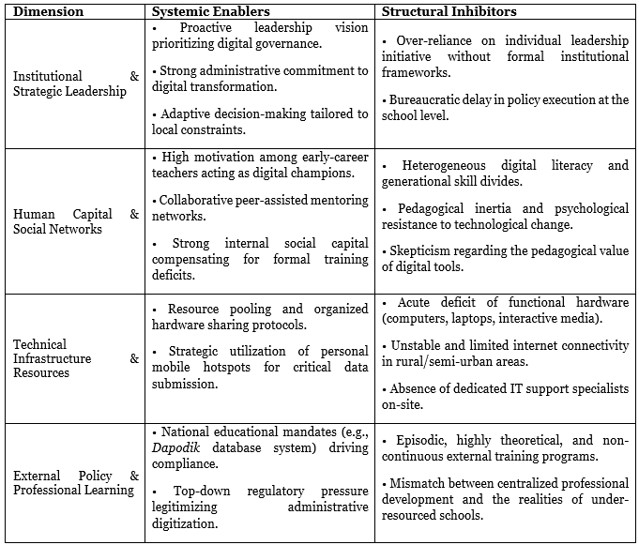
The evolution of educational technology requires primary school leaders to navigate digital transformation, yet mainstream digital leadership frameworks often overlook the realities of under-resourced schools. This study investigates the operationalization of Smart School Leadership (SSL) within a resource-constrained primary school setting, examining how school administrators adapt leadership practices amid material and structural limitations. Employing a qualitative single-case study design, data were collected through semi-structured interviews, direct field observations, and institutional artifact analysis involving eight participants, including the school principal, instructional teachers, and administrative personnel at SD Negeri 1 Simbune, Indonesia. Data were analyzed using interactive qualitative condensation, thematic displays, and continuous verification. The findings reveal that SSL implementation operates through an adaptive, staged transition rather than a sudden digital overhaul. Leadership practices are strategically prioritized toward core administrative workflows, compliance database management, and basic data-driven decision-making to address foundational early-grade literacy and numeracy needs. Furthermore, internal social capital and informal distributed leadership structures, specifically peer-assisted mentoring led by tech-savvy junior educators, serve as critical compensatory mechanisms to bridge faculty digital literacy divides. However, persistent structural friction, including hardware scarcity, unstable internet connectivity, pedagogical inertia, and non-systemic external training programs, places a clear ceiling on advancing to fully integrated digital pedagogy. This study implies that policymakers must move beyond uniform technology mandates toward equity-focused infrastructure allocation and continuous, school-based professional development tailored to rural primary school contexts.
References
Abubakar, A., Aspin, A., & Nurdiansyah, E. S. (2026). Fostering humanistic decision-making in elementary science education amid artificial intelligence disruption: A case study of a school principal. Jurnal Penelitian Pendidikan IPA, 12(6), 374–383.
Alenezi, A. (2023). Digital leadership in education: A systematic review. Education and Information Technologies, 28(4), 4501–4523.
Aspin, A., Nugroho, I. A., Abubakar, A., & Suleman, M. A. (2025). Integration of Internet of Things (IoT) and ChatGPT in the teaching of photosynthesis and water quality at SDN 2 Lebo. Jurnal Penelitian Pendidikan IPA, 11(7), 844–853.
Baxter, J., Floyd, A., & Morales, A. (2025). Strategy as learning in digital education contexts. School Leadership & Management, 45(1), 53–83.
Ghamrawi, N., & Tamim, R. M. (2023). A typology for digital leadership in education. Education and Information Technologies, 28(6), 7089–7110.
Hallinger, P. (2021). Leadership and teacher learning in the digital era. Educational Management Administration & Leadership, 49(3), 398–412.
Nababan, T. M., Sihombing, S., & Situmorang, R. (2021). School leadership strategies in the digital era. Advances in Social Science, Education and Humanities Research, 600, 312–317.
Okunlola, J. O. (2024a). Digital leadership: Shaping school effectiveness in the digital era. Educational Technology Quarterly, 2024(1), 45–58.
Okunlola, J. O. (2024b). Drivers and barriers of digital leadership practice in education. Journal of Education, Learning and Technology, 5(2), 89–101.
Putri, E. D., & Sary, F. P. (2025). Digital leadership and teacher performance in smart school settings. International Research Journal of Economics and Management Studies, 4(11), 124–132.
Rasdiana, R., Wiyono, B. B., & Imron, A. (2024). Elevating teachers’ professional digital competence through leadership. Education Sciences, 14(3), 266–280.
Reis-Andersson, J. (2024). Leading the digitalisation process in K–12 schools. Education and Information Technologies, 29(3), 2585–2603.
Ridho, M. R., Wiyono, B. B., & Mustiningsih, M. (2024). Digital leadership of school principals in driving organizational innovation. Insania, 29(1), 45–59.
Ruloff, M., & Petko, D. (2021). School principals’ leadership styles for digital transformation: Results from a cluster analysis. School Leadership & Management, 41(4), 310–328.
Sari, F., & Aydin, H. (2023). The role of digital leadership in teacher professional development and learning environments. Sustainability, 15(5), 4031–4045.
Spiteri, S., & Chang Rundgren, M. (2022). Digital competence and attitudes toward technology in primary education. Education Sciences, 12(3), 173–188.
Witthöft, J., Aydin, B., & Pietsch, M. (2025). Leading digital innovation in schools: The role of transformational and digital leadership. Journal of Research on Technology in Education, 57(2), 210–228.
Zhu, C., & Engels, N. (2022). Organizational culture and instructional innovations in digital transformation contexts. Educational Technology Research and Development, 70(1), 115–132.
Published
How to Cite
Issue
Section
License
Copyright (c) 2026 Aurel Isma Wardani, Aspin Aspin, Abubakar Abubakar, Feni Febrianti, Ainul Basyirah

This work is licensed under a Creative Commons Attribution-ShareAlike 4.0 International License.
Most read articles by the same author(s)
- Feni Febrianti, Muh Ainul Basyirah, Implementing Learning-Based Models to Enhance Reading Comprehension Skills in Elementary School Students , Journal of Society Innovation and Development: Vol. 4 No. 1 (2022): JSID: November 2022
- Feni Febrianti, Anisa Ainul Mardiah, May Yati, Badrun Islma, Siti Julaika, Culturally Responsive Pedagogy in Primary Education: Leveraging Bima Local Wisdom to Foster Student Learning Independence , Journal of Society Innovation and Development: Vol. 8 No. 1 (2026): JSID: November 2026
- Annisa Ilmeira Queen, Aspin Aspin, Ishak Bagea, Feni Febrianti, Ainul Basyirah, Driving Elementary Digital Literacy: Technology-Based Principal Leadership in Resource-Constrained Schools , Journal of Society Innovation and Development: Vol. 8 No. 1 (2026): JSID: November 2026
- Firman Firman, Ishak Bagea, Aspin Aspin, Abubakar Abubakar, Feni Febrianti, Bridging the EdTech Divide Under Resource Constraints: How a Rural Principal Navigated Resource Scarcity to Elevate Learning Quality , Journal of Society Innovation and Development: Vol. 8 No. 1 (2026): JSID: November 2026
- Nabila Ratu Fidella, Abubakar Abubakar, Ishak Bagea, Feni Febrianti, Muh Ainul Basyirah, Driving Educational Quality in Resource-Constrained Schools: A Mixed-Methods Study on ICT Integration and Pedagogical Adaptation , Journal of Society Innovation and Development: Vol. 8 No. 1 (2026): JSID: November 2026
.png)

%20(4).png)
.png)
.png)
.png)


.png)
.png)
.png)