How Secondary Students Develop Grammar Skills through Integrated- Skill Activities
DOI:
https://doi.org/10.63924/jsid.v8i1.286Keywords:
Grammar Skills Development, Integrated-Skill Activities, Secondary Students, English Language Teaching, Grammar AchievementAbstract
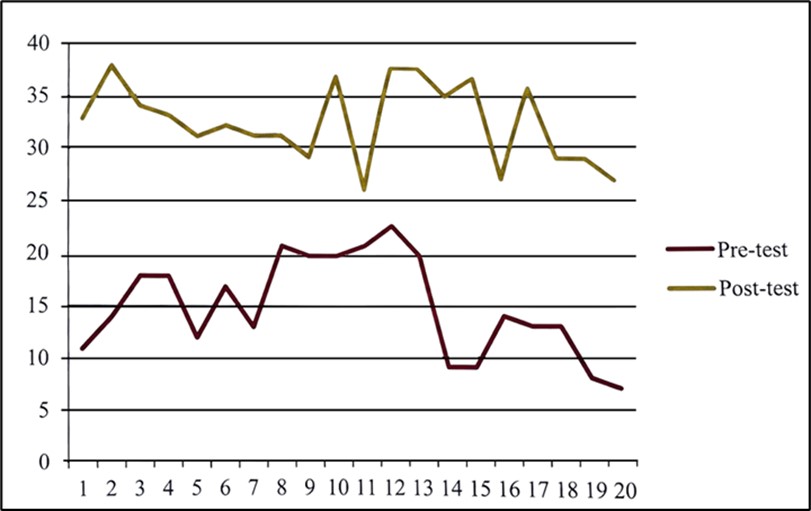
Traditional English language pedagogy often treats grammar as isolated units of declarative knowledge, failing to foster real-time communicative proficiency during authentic production. To address this issue, this study investigated the effectiveness of an integrated-skill approach in teaching eight specific grammar patterns and explored student attitudes toward this framework. A quantitative quasi-experimental research design was implemented with twenty Secondary I English as a Foreign Language (EFL) learners at a private language center in Myanmar over a three-month instructional intervention. Data were collected using diagnostic pre-tests, identical parallel post-tests, and two multi-item closed-ended questionnaires, and analyzed using descriptive and inferential statistics. The empirical findings from a paired-samples t-test demonstrated a statistically significant improvement in overall morphosyntactic competence from the pre-test (M = 15.05) to the post-test (M = 32.55; p < .001). However, granular structural analysis revealed that development was not uniform. Rule-governed structures like the present simple passive and exclamations showed substantial accuracy gains, whereas lexically complex items like past participles experienced a clear performance plateau. Perceptually, the multi-skill task framework generated highly positive attitudes by increasing classroom interaction, though a notable paradox emerged as learners frequently experienced cognitive processing strains during dense receptive input activities. These outcomes imply that the conversion of declarative knowledge into automatic performance depends heavily on structural complexity. Curriculum designers and educators must systematically combine communicative fluency with guided, explicit focus-on-form interventions to ensure that young learners actively notice and process difficult syntactic patterns during multi-skill tasks.
References
Anderson, N. J. (2005). L2 learning strategies. Oxford University Press.
Azar, B. S. (2007). Grammar-based teaching: A practitioner's perspective. TESL-EJ, 11(2), 1–12.
Brown, H. D. (2007). Principles of language learning and teaching (5th ed.). Pearson Education.
Celce-Murcia, M., & Olshtain, E. (2000). Discourse and context in language teaching. Cambridge University Press.
Crystal, D. (2004). Rediscover grammar (3rd ed.). Pearson Education.
DeKeyser, R. (2020). Skill acquisition theory. Dalam B. VanPatten & J. Williams (Eds.), Theories in second language acquisition: An introduction (3rd ed., hlm. 83–104). Routledge.
DeKeyser, R. (2022). Skill acquisition theory in SLA. Dalam The Routledge handbook of second language acquisition and individual differences (hlm. 83–96). Routledge.
Ellis, R. (2006). Current issues in the teaching of grammar. TESOL Quarterly, 40(1), 83–107.
Ellis, R. (2023). Focus on form: A critical review of theory and research. Language Teaching Research, 27(4), 811–834. https://doi.org/10.1177/1362168820921435
Hadfield, J., & Hadfield, C. (2008). Introduction to teaching English. Oxford University Press.
Harmer, J. (2007). The practice of English language teaching (4th ed.). Pearson Longman.
Hinkel, E. (2010). Integrating the four skills: Current and historical perspectives. Oxford University Press.
Hirahata, A. (2013). A study of integrating the four skills and grammar-focused classes in Japanese public high schools. Language Education Studies, 8(2), 45–59.
Kalend, O. (2011). The role of grammar in communicative language teaching. Journal of Language and Linguistic Studies, 7(2), 112–128.
Kim, Y. (2008). The effects of integrated language-based instruction in elementary ESL learning. The Modern Language Journal, 92(3), 431–445. https://doi.org/10.1111/j.1540-4781.2008.00755.x
Krashen, S. D. (1985). The input hypothesis: Issues and implications. Longman.
Larsen-Freeman, D. (2009). Teaching and testing grammar. Dalam M. Long & C. Doughty (Eds.), The handbook of language teaching (hlm. 518–542). Wiley-Blackwell.
Larsen-Freeman, D. (2023). Doing complexity theory in SLA: Principles and practices. The Modern Language Journal, 107(1), 12–25. https://doi.org/10.1111/modl.12818
Lightbown, P. M., & Spada, N. (2021). How languages are learned (5th ed.). Oxford University Press.
Long, M. H. (2021). Optimal input: Focus on form in second language acquisition. Georgetown University Press.
Mochizuki, N., & Ortega, L. (2008). Balancing communication and grammar in beginning-level foreign language classrooms. Language Teaching Research, 12(1), 11–37. https://doi.org/10.1177/1362168807084492
Molina, M. E. (2011). The influence of skill integration on second-grade high school students' English performance. Journal of Language Teaching and Research, 2(4), 873–879. https://doi.org/10.4304/jltr.2.4.873-879
Mulroy, D. (2003). The war against grammar. Boynton/Cook Publishers.
Nassaji, H. (2021). The role of explicit and implicit instruction in modern grammar pedagogy. System, 96, Artikel 102410. https://doi.org/10.1016/j.system.2020.102410
Nunan, D. (1998). Teaching grammar in context. ELT Journal, 52(2), 101–109. https://doi.org/10.1093/elt/52.2.101
Oxford, R. L. (2001). Integrated skills in the ESL/EFL classroom. ESL Magazine, 6(1), 18–20.
Richards, J. C., & Renandya, W. A. (2002). Methodology in language teaching: An anthology of current practice. Cambridge University Press.
Sato, M., & Loewen, S. (2022). Interaction, feedback, and grammar acquisition in communicative classrooms. Studies in Second Language Acquisition, 44(2), 345–369. https://doi.org/10.1017/S027226312100025X
Su, Y. C. (2007). Students' changing views and the integrated-skills approach in Taiwan's EFL college classes. Education Research Institute Journal, 15(1), 55–72.
Swain, M., & Lapkin, S. (1989). Canadian immersion and adult second language teaching: What's the connection? The Modern Language Journal, 73(2), 150–159. https://doi.org/10.1111/j.1540-4781.1989.tb02537.x
Thornbury, S. (1999). How to teach grammar. Pearson Education.
Ur, P. (2011). Grammar practice activities (2nd ed.). Cambridge University Press.
VanPatten, B. (2020). Input processing in second language acquisition. Routledge.
Published
How to Cite
Issue
Section
License
Copyright (c) 2026 Hnin Ze Khine, Hnin Ze Hlaing

This work is licensed under a Creative Commons Attribution-ShareAlike 4.0 International License.
Most read articles by the same author(s)
- Hnin Ze Hlaing, Hnin Ze Khine, How Pre-School Aged Siblings Influence Toddlers' Language Development , Journal of Society Innovation and Development: Vol. 7 No. 2 (2026): JSID: May 2026
.png)

%20(4).png)
.png)
.png)
.png)


.png)
.png)
.png)