How Pre-School Aged Siblings Influence Toddlers' Language Development
DOI:
https://doi.org/10.63924/jsid.v7i2.267Keywords:
First Language Development, Toddlers, Two-Word Stage, Semantic Relations, Behaviorist Theory, Mean Length of Utterance (MLU), Behavioral Language Input, Sibling InfluenceAbstract
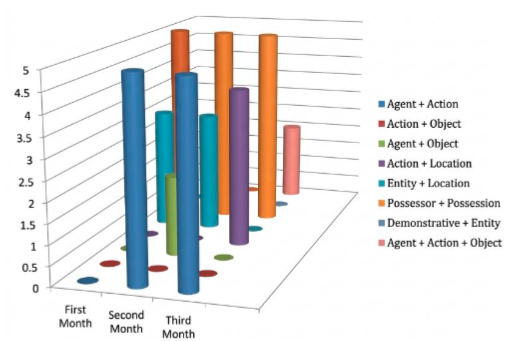
This study explores early first language development in toddlers, focusing on how children acquire semantic relations at the two-word stage. The purpose of the research is to examine this development through the lens of behaviorist theory and to investigate the influence of behavioral language input from family members, particularly mothers and siblings. The study involves four toddlers aged 24–28 months and compares two groups: children with no siblings and those with preschool-aged siblings. Data was collected over a three-month period through observation of the children’s utterances, with analysis focusing on Mean Length of Utterance (MLU) measured three times and the types of semantic relations produced. The results indicate that children exposed to richer behavioral language input, especially those with older siblings, tend to show greater development in MLU and a wider range of semantic relations. These findings suggest that interaction within the home environment plays a significant role in language development at the two-word stage. The study highlights the importance of providing consistent and meaningful language input to support early linguistic growth in young children.
References
Bates, E., & Goodman, J. C. (1997). On the inseparability of grammar and the lexicon: Evidence from acquisition. Language and Cognitive Processes, 12(5–6), 507–584.
Bavin, E. (1992). The acquisition of Walpiri. In D. I. Slobin (Ed.), The cross-linguistic study of language acquisition (Vol. 3, pp. 309–372). Lawrence Erlbaum Associates.
Bennett, D. L. (2012). Understanding the stages of baby babble.
Berk, L. E. (2013). Child development (9th ed.). Pearson.
Bloom, L. (1973). One word at a time: The use of single word utterances before syntax. Mouton.
Brown, R. (1973). A first language: The early stages. Harvard University Press.
Bruner, J. S. (1983). Child’s talk: Learning to use language. Oxford University Press.
Chomsky, N. (1959). A review of B. F. Skinner’s Verbal behavior. University of Minnesota.
Clark, E. V. (2009). First language acquisition (2nd ed.). Cambridge University Press.
Cohen, L. (1994). Research methods in education (4th ed.). Croom Helm.
Crystal, D. (2006). How language works. Penguin Books.
De Houwer, A. (2009). An introduction to bilingual development. Multilingual Matters.
Fenson, L., Dale, P. S., Reznick, J. S., Bates, E., Thal, D. J., & Pethick, S. J. (1994). Variability in early communicative development. Monographs of the Society for Research in Child Development.
Fromkin, V., Rodman, R., & Hyams, N. (2014). An introduction to language (10th ed.). Cengage Learning.
Gleitman, L. R., & Newport, E. L. (1995). The invention of language by children. In L. R. Gleitman & M. Liberman (Eds.), An invitation to cognitive science (Vol. 1, pp. 1–24). MIT Press.
Goldfield, B. A., & Reznick, J. S. (1990). Early lexical acquisition: Rate, content, and the vocabulary spurt. Journal of Child Language, 17(1), 171–183.
Greenfield, P. M., & Smith, J. H. (1976). The structure of communication in early language development. Academic Press.
Hoff, E. (2013). Language development (5th ed.). Wadsworth.
Kuhl, P. K. (2004). Early language acquisition: Cracking the speech code. Nature Reviews Neuroscience, 5(11), 831–843.
Lenneberg, E. H. (1967). Biological foundations of language. Wiley.
Lightbown, P. M., & Spada, N. (1993). How languages are learned. Oxford University Press.
Lightbown, P. M., & Spada, N. (2006). How languages are learned (3rd ed.). Oxford University Press.
Malmeer, E., & Assadi, N. (2013). Language production and comprehension: The effect of preschool-aged siblings on toddlers’ language development. Theory and Practice in Language Studies, 3(7), 1231–1237.
Nelson, K. (1973). Structure and strategy in learning to talk. Monographs of the Society for Research in Child Development, 38(1–2), 1–135.
Nwokah, E. E. (1987). Maidese vs. motherese: Is the language input different? Language and Speech, 30, 213–237.
O’Grady, W. (2005). How children learn language. Cambridge University Press.
Okelo, W. E. (2013). The influence of sibling presence on language acquisition of young children. University of Nairobi.
Owens, R. E. (2001). Language development (2nd ed.). Allyn & Bacon.
Owens, R. E. (2005). Language development: An introduction (7th ed.). Pearson Education.
Pavlov, I. P., & Watson, J. B. (1926). Lectures on conditioned reflexes (W. H. Gantt, Trans.). Allen & Unwin.
Pinker, S. (1994). The language instinct. William Morrow.
Skinner, B. F. (1957). Verbal behavior. Appleton-Century-Crofts.
Snow, C. E. (1972). Mothers’ speech to children learning language. Child Development, 43(2), 549–565.
Tomasello, M. (2003). Constructing a language: A usage-based theory of language acquisition. Harvard University Press.
Vygotsky, L. S. (1978). Mind in society: The development of higher psychological processes. Harvard University Press.
Published
How to Cite
Issue
Section
License
Copyright (c) 2026 Hnin Ze Hlaing, Hnin Ze Khine

This work is licensed under a Creative Commons Attribution-ShareAlike 4.0 International License.
Most read articles by the same author(s)
- Hnin Ze Khine, Hnin Ze Hlaing, How Secondary Students Develop Grammar Skills through Integrated- Skill Activities , Journal of Society Innovation and Development: Vol. 8 No. 1 (2026): JSID: November 2026
.png)

%20(4).png)
.png)
.png)
.png)


.png)
.png)
.png)