Women’s Resistance in Serat Candrarini through a Jacques Derrida Deconstructive Reading
DOI:
https://doi.org/10.63924/jsid.v8i1.373Keywords:
Serat Candrarini, Deconstruction, Women’s Resistance, Jacques Derrida, Compliance as StrategyAbstract
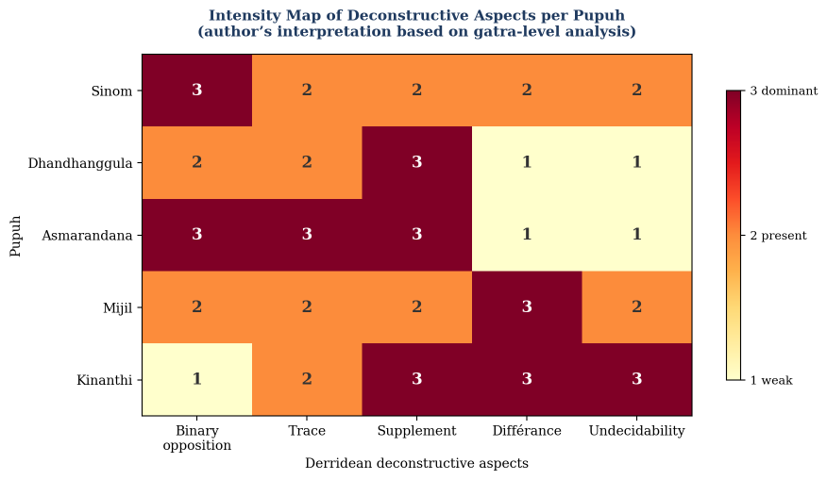
Serat Candrarini (SCR), a 19th-century Javanese didactic text by R. Ng. Ranggawarsita commissioned by Pakubuwana IX, is conventionally read as a manual of wifely obedience within the palace polygamous household. Previous deconstructive work on SCR (Iryani & Suryaman, 2025) remained confined to the aspect of binary opposition. This study extends that reading by applying five aspects of Jacques Derrida’s deconstruction; binary opposition, différance, trace, supplement, and undecidability to the five pupuh of SCR (Sinom, Dhandhanggula, Asmarandana, Mijil, and Kinanthi), addressing two questions: (1) how the five deconstructive aspects manifest in the macapat verses of SCR; and (2) what forms of women’s resistance such a reading reveals. Employing a qualitative-deconstructive approach to the digital manuscript of SCR held by the Perpustakaan Reksa Pustaka, Pura Mangkunegaran, data were gathered through document study and close reading, then analysed following the data condensation, data display, and conclusion drawing and verification model (Miles, Huberman, & Saldaña, 2019). The findings show the five aspects to be interlinked: the seemingly hierarchical and stable binary opposition depends on the subordinated element as its supplement; this dependence leaves a trace that displaces meaning through différance, culminating in undecidability. From these fissures of meaning emerge four forms of women’s resistance: passive, symbolic, discursive, and cultural. Women’s compliance in SCR is therefore not always identical with submission; it can be read as strategy a negotiation conducted from within the patriarchal structure. These findings enrich the study of wulang literature and the deconstruction of Nusantara literature while offering material for critical-deconstructive literacy in classical Javanese literature pedagogy.
References
Anggraeni, M., & Suyanto, S. (2017). Ajaran tentang Bakti Istri kepada Suami dalam Serat Wulang Reh Putri. Nusa: Jurnal Ilmu Bahasa Dan Sastra, 12(2), 108–117. https://doi.org/10.14710/NUSA.12.2.108-117
Aprilia, C., & Arianto, T. (2021). Binary Oppositions As The Result Of Deconstruction Analysis In The Goldfinch Novel By Donna Tartt. JURNAL BASIS, 8(1), 65–74. https://doi.org/10.33884/basisupb.v8i1.2812
Barragan, S., Erogul, M. S., & Essers, C. (2018). ‘Strategic (dis)obedience’: Female entrepreneurs reflecting on and acting upon patriarchal practices. Gender, Work & Organization, 25(5), 575–592. https://doi.org/10.1111/gwao.12258
Butler, J. (2006). Gender Trouble : Feminism and the Subversion of Identity. Routledge. https://doi.org/10.4324/9780203824979
Butt, G. S., & Ghauri, I. U. R. (2022). Theory of Deconstruction: A Comparative Study of the Views of Western and Muslim Theorists and Philosophers. Al-Jami’ah: Journal of Islamic Studies, 60(1), 131–166. https://doi.org/10.14421/ajis.2022.601.131-166
Cekaite, A. (2020). Subversive compliance and embodiment in remedial interchanges. Text & Talk, 40(5), 669–693. https://doi.org/10.1515/text-2020-2078
Chaudhary, N., & Dutt, A. (2022). Women as Agents of Change: Exploring Women Leaders’ Resistance and Shaping of Gender Ideologies in Pakistan. Frontiers in Psychology, 13. https://doi.org/10.3389/fpsyg.2022.800334
Culler, J. (1997). Literary Theory: A Very Short Introduction. Oxford University Press.
Deer, J. (2020). Deconstruction. Oxford Research Encyclopedia of Literature. https://doi.org/10.1093/ACREFORE/9780190201098.013.1015
Derrida, J. (1974). Of Grammatology. The Johns Hopkins University Press .
Evink, E. (2020). Différance as Temporization and Its Problems. International Journal of Philosophical Studies, 28(3), 433–451. https://doi.org/10.1080/09672559.2020.1766885
Fadilah, M. R., Werdiningsih, Y. K., & Sulanjari, B. (2021). Pola Pikir Perempuan dalam 5 Lagu Campursari Populer Tahun 2019-Awal 2020 Kajian Dekonstruksi. JISABDA: Jurnal Ilmiah Sastra Dan Bahasa Daerah, Serta Pengajarannya, 2(2), 50–62. https://journal.upgris.ac.id/index.php/jisabda/article/view/7811
Faidah, O. N. (2023). Citra Wanita Jawa Dalam Serat Candrarini : Kajian Semiotik. Vilvatikta: Jurnal Pengembangan Bahasa Dan Sastra Daerah, 1. https://afeksi.id/journal3/index.php/jpbd/index
Fitriana, A. (2019). Representasi Perempuan Jawa Dalam Serat Wulang Putri: Analisis Wacana Kritis. Paradigma: Jurnal Kajian Budaya, 9(3), 213. https://doi.org/10.17510/PARADIGMA.V9I3.322
Florida, N. K. . (1993). Javanese Literature in Surakarta Manuscripts : Introduction and Manuscripts of the Karaton Surakarta. Southeast Asia Program, Cornell University.
Foucault, M. (1972). Archaeology of Knowledge. Routledge. https://doi.org/10.4324/9780203604168
Foucault, M. (2013). Archaeology of Knowledge. Routledge. https://doi.org/10.4324/9780203604168
Goldgaber, D. (2020). Speculative Grammatology. Edinburgh University Press. https://doi.org/10.1515/9781474438353
Handajani, S. (2022). Theorizing Beauty Regimes: Indonesian Women Performing their Gender Ideology and Resistance through Makeup. Jurnal Humaniora, 34(2), 108. https://doi.org/10.22146/jh.69020
Hasanah, M., & Adawiyah, R. (2021). Diferensiasi Konsep Perempuan Tiga Zaman: Kajian Dekonstruksi Jacques Derrida. LITERA, 20(1), 1–28. https://doi.org/10.21831/LTR.V20I1.39036
Hastuti, D. L., Santosa, I., & Syarief, A. (2024). Javanese women and their noble values: From Påncå Wastå to Kåncå Wingking in Mangkunegaran Principality, Surakarta, Indonesia. Kervan. International Journal of African and Asian Studies, 28(2), 463–489. https://doi.org/10.13135/1825-263X/11501
Hidayat, R., Rohanda, R., & S, D. Y. (2025). Power Domination and Resistance in Nawal El Saadawi’s Mawtu Ma’ali Al-Waziri Sabiqan: Antonio Gramsci’s Hegemony. Jurnal Adabiyah, 25(2), 376–400. https://doi.org/10.24252/jad.v25i2a8
Holmes, D. (2021). La teoría literaria feminista y la figura de la lectora. Tropelías: Revista de Teoría de La Literatura y Literatura Comparada, 36(36), 51–68. https://doi.org/10.26754/ojs_tropelias/tropelias.2021365319
Iryani, E., & Suryaman, M. (2025). Gender Relations through Binary Opposition in Serat Candrarini and Its Implications for Education Equality. Piwulang: Jurnal Pendidikan Bahasa Jawa, 13(2), 167–180. https://doi.org/10.15294/piwulang.v13i2.25586
Ismawati, E., Amertawengrum, I. P., & Sukini. (2022). Life of Javanese women in literature text and the real world. International Journal of Research and Innovation in Social Science, 06(10), 731–739. https://doi.org/10.47772/IJRISS.2022.61036
Johansson, A., & Vinthagen, S. (2016). Dimensions of Everyday Resistance: An Analytical Framework. Critical Sociology, 42(3), 417–435. https://doi.org/10.1177/0896920514524604
Johnson, A. (2005). The Gender Knot: Unraveling Our Patriarchal Legacy . Temple University Press. www.agjohnson.us.
Krippendorff, K. (2022). Sage Research Methods | Content Analysis: An Introduction to Its Methodology. In Sage Research Methods. https://doi.org/10.4135/9781071878781
Kurniasih, R. M. (2024). Wujud Dekonstruksi Jacques Derrida dalam Novel Carita Calin Karya Aprilia Fatmawati. Haluan Sastra Budaya, 8(2), 228. https://doi.org/10.20961/HSB.V8I2.76843
Kuswaya, A., & Ma’mun, S. (2020). Misinterpretation of Patience: An Analytical Study of Nerimo Concept within the Indonesian Muslim Society. Indonesian Journal of Islam and Muslim Societies, 10(1), 153–176. https://doi.org/10.18326/ijims.v10i1.153-176
Mahmood, S. (2005). Politics of Piety: The Islamic Revival and the Feminist Subject. In Politics of Piety. Princeton University Press. https://doi.org/10.2307/J.CTVCT00CF
Mahmudin, A. S. (2021). Women’s Self Actualization in The Family (Moral Teaching in Serat Wulang Reh Putri). Nazhruna: Jurnal Pendidikan Islam, 4(2), 180–194. https://doi.org/10.31538/nzh.v4i2.1422
Martínez Aguilar, E. D., Witjes, S., & Bos, R. ten. (2025). Deconstruction as a Research Strategy for Discourse Studies: An Aporetic and Iterable Model for Opening Discourses. International Journal of Qualitative Methods, 24, 1–16. https://doi.org/10.1177/16094069251349470
Miles, M. B., Huberman, A. M., & Johnny, S. (2014). Qualitative Data Analysis: A Methods Sourcebook (Third Edition). SAGE Publications.
Mousavilar, A.-S., & Pourmahmoud, S. (2021). A Comparative Study of Derrida’s Binary Opposition in Escher’s Day and Night. Revista de Humanidades, 42, 11. https://doi.org/10.5944/rdh.42.2021.28496
Nartey, M. (2024). Women’s voice, agency and resistance in Nigerian blogs: A feminist critical discourse analysis. Journal of Gender Studies, 33(4), 418–430. https://doi.org/10.1080/09589236.2023.2246138
Neisya. (2017). Deconstruction Of ‘Priayi” Javanese Family Patriarchy Issue In Novel Canting By Arswendo Atmowiloto.
Nugraha, D., Suwondo, & Suyitno. (2020). PEMBACAAN BERPERSPEKTIF EKOFEMINISME ATAS SAJAK “ISTERI” KARYA DARMANTO JATMAN (Ecofeminism Reading on Darmanto Jatman’s Poem “Isteri”). Kandai, 16(1), 77. https://doi.org/10.26499/jk.v16i1.1758
Nugraha, F. I., Saraswati, E., & Widodo, J. (2020). Dekonstruksi Jackques Derrida dalam Novel O Karya Eka Kurniawan. Jurnal Ilmiah FONEMA, 3(1), 27–42. https://doi.org/10.25139/FN.V3I1.2394
Nugroho, Y. E., Widodo, S. T., Wasino, & Pardi. (2024). Patriarchal hegemony of Javanese kings power in Wulang Putri text. Cogent Arts and Humanities, 11(1). https://doi.org/10.1080/23311983.2024.2335778
Patel, Taran, Romani, Laurence, Oberoi, Poonam, & Ramasamy, Chandra. (2023). Gender role encapsulation as resistance to patriarchy: Women politicians’ work and gender equality in India. Organization, 30(2), 307–325. https://doi.org/10.1177/1350508421995764
Pikatan, I. (2012). Ajaran Berumah Tangga Dalam Serat Candrarini Karya Ranggawarsita (Tinjauan Sosiologi Sastra). Jurnal Penelitian Humaniora, 13(1), 42–48.
Pramitasari, D. A., & Widagdo, S. (2024). Studi eksplorasi nilai-nilai Serat Wulang Putri Nyi Adisara: respon pembaca perempuan jawa masa kini. Aksara: Jurnal Bahasa Dan Sastra, 25(2), 455–469. https://doi.org/10.23960/aksara/v25i1.pp455-469
Ranggawarsita. (1863). Serat Candrarini. Reksapustaka Pura Mangkunegaran.
Rohmatin, F. (2019). Dekonstruksi Wacana Patriarki dan Kebungkaman Perempuan dalam Manuskrip Hikayat Darma Tasiyah. Jumantara, 10(2). https://ejournal.perpusnas.go.id/jm/article/view/01000220193/pdf_1
Rubenstein, D. (2014). Derrida, Jacques (1930–2004). In The Encyclopedia of Political Thought (pp. 888–896). Wiley. https://doi.org/10.1002/9781118474396.wbept0261
Saikhudin, M., & Dewi, E. (2026). Jacques Derrida’s Deconstruction: Theory, Method and Its Application in Text and Discourse Studies. Edusoshum : Journal of Islamic Education and Social Humanities, 6(3), 1600–1606. https://doi.org/10.52366/edusoshum.v6i3.476
Scott, J. C. (1985). Weapons of the Weak : Everyday Forms of Peasant Resistance. Yale University Press.
Scott, J. C. . (1990). Domination and the Arts of Resistance : Hidden Transcripts. Yale University Press.
Sherma, A. B. (2026). Deconstruction theory and queer theory: a state of flux and multiplicity of meaning. Cogent Arts & Humanities, 13(1), 2647136. https://doi.org/10.1080/23311983.2026.2647136
Spivak, G. C. (2010). Can the subaltern speak?: Reflections on the History of an Idea. In Columbia University Press. https://doi.org/10.4324/9781351244756-5
Verma, D. D. K., & Verma, D. A. (2025). The Poetics of Silence: Reimagining Voice and Absence in Contemporary Women’s Writing. International Journal of Scientific Research in Humanities and Social Sciences, 2(5), 84–91. https://doi.org/10.32628/IJSRHSS2525130
Wahjono, P. (2004). Sastra Wulang dari Abad XIX: Serat Candrarini Suatu Kajian Budaya. Makara Human Behavior Studies in Asia, 8(2), 71–82. https://doi.org/10.7454/mssh.v8i2.91
Walby, S. (1989). THEORISING PATRIARCHY. Sage Publisher . https://www.jstor.org/stable/42853921
Waqiah, N. F., Karman, A., & Abidin, A. (2026). Dekonstruksi Narasi Sejarah Dan Identitas Dalam Novel Amba Karya Laksmi Pamuntjak: Analisis Poststrukturalisme Jacques Derrida. Didaktik : Jurnal Ilmiah PGSD STKIP Subang, 12(02), 162–171. https://doi.org/10.36989/DIDAKTIK.V12I02.12792
Winarti, W., & Erlinawati, M. (2025). Deconstruction In The Short Story Burung Kecil Dan Hujan By Yanusa Nugroho. FRASA: ENGLISH EDUCATION AND LITERATURE JOURNAL, 6(1), 1–11. https://doi.org/10.47701/frasa.v6i1.4804
Ybema, S., & Horvers, M. (2017). Resistance Through Compliance: The Strategic and Subversive Potential of Frontstage and Backstage Resistance. Organization Studies, 38(9), 1233–1251. https://doi.org/10.1177/0170840617709305
Zulfikar, M. F., Saryono, D., Syahri, M., & Jumahar. (2024). Teori Resistansi James C. Scott Sebagai Kajian Representasi Sastra. Multatuli: Jurnal Bahasa Dan Sastra Indonesia, 01(1). https://ejournal.uit-lirboyo.ac.id/index.php/Multatuli/article/view/6200/1978
Published
How to Cite
Issue
Section
License
Copyright (c) 2026 Evi Iryani, Maman Suryaman, Ahmad Taufiq

This work is licensed under a Creative Commons Attribution-ShareAlike 4.0 International License.
Most read articles by the same author(s)
- Ahmad Taufiq, The Cognitive Cost of Sad Films: Emotional Media and Decision-Making Impairment , Journal of Society Innovation and Development: Vol. 3 No. 2 (2022): JSID: May 2022
- Ahmad Taufiq, Narrative Influence in the Digital Age: How Digital Literature Shapes Consumer Behavior , Journal of Society Innovation and Development: Vol. 2 No. 2 (2021): JSID: May 2021
- Ahmad Taufiq, Viona Erika Jaya, Analyzing the Forms of Place Deixis and Discourse Deixis in Laki-Laki Sejati Short Story by Putu Wijaya , Journal of Society Innovation and Development: Vol. 7 No. 1 (2025): JSID: November 2025
- Muhammad Saiful Mukminin, Evi Iryani, Mahen’s song ‘Pura-pura Lupa’ in English by Emma Hesters: Translation Techniques, Methods, and Ideologies Analysis , Journal of Society Innovation and Development: Vol. 6 No. 2 (2025): JSID: May 2025
- Azhari Azhari, Ahmad Taufiq, Muhammad Zikrullah, Beyond Fluency: Language Attitudes, Identity, and Preservation Intentions Among Young Diaspora Speakers of Usku, Papua , Journal of Society Innovation and Development: Vol. 8 No. 1 (2026): JSID: November 2026