Beyond Fluency: Language Attitudes, Identity, and Preservation Intentions Among Young Diaspora Speakers of Usku, Papua
DOI:
https://doi.org/10.63924/jsid.v8i1.364Keywords:
Usku Language, Language Shift, Papuan Language Isolate, Youth Identity, Language AttitudeAbstract
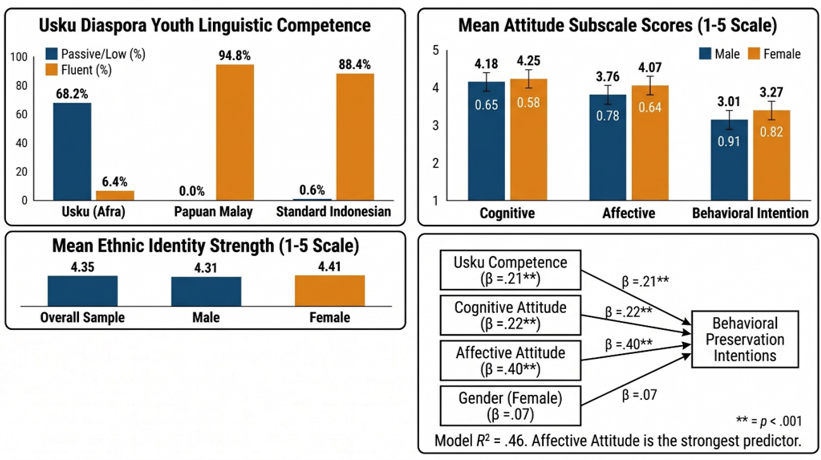
The rapid shift toward dominant lingua francas threatens Papua’s extraordinary linguistic diversity, placing moribund isolates like Usku (Afra) at immediate risk of extinction. This study investigates the language attitudes, ideologies, and ethnic identity negotiations of the young Usku diaspora generation residing outside their ancestral territory in Keerom Regency, Papua. Using a quantitative cross-sectional design, data were collected from N=173 diaspora youth (100 males, 73 females) through a structured questionnaire and analyzed using JASP Statistics. The empirical results reveal a pronounced asymmetry between low self-reported Usku competence (M=1.84) and high cognitive (M=4.21) and affective (M=3.89) language attitudes. Crucially, structural language competence showed no statistically significant correlation with ethnic identity strength (r=.12, p=.116), demonstrating that youth decouple active fluency from ethnic self-identification. Inferential testing identified a significant gender difference in affective attachment, with young women exhibiting higher emotional attachment to the heritage language than men (p=.006). Multiple linear regression indicated that affective attitude is the strongest predictor of youth preservation intentions (β=.40, p<.001), outranking cognitive valuation and baseline fluency. These findings imply that classical models linking fluency loss directly to identity erosion must be re-evaluated in Papuan diaspora contexts. Furthermore, effective revitalization initiatives must move beyond traditional grammatical codification to prioritize emotionally engaging, youth-centered, and culturally immersive platforms.
References
Almalki, A., Smith, A., Elola, I., & Kaplan, H. (2026). Between Worlds: two portraits of language knowledge, belonging, and cultural connection among Spanish heritage speakers. Languages, 11(3), 59. https://doi.org/10.3390/languages11030059
Alyami, N. A. (2023). Readings in Language Shift Studies from the Past to the Present: Review Article. International Journal of Linguistics Literature & Translation, 6(6), 21–41. https://doi.org/10.32996/ijllt.2023.6.6.3
Awal, A. (2024). Endangered Languages: A Systematic Qualitative Study of Socio-Cultural Impacts and Revitalisation. Sustainable Multilingualism, 25, 65 - 101. https://doi.org/10.2478/sm-2024-0013
Bennett, J. (2020). Mothering through Language: Gender, Class, and Education in Language Revitalization among Kaqchikel Maya Women in Guatemala. Journal of Linguistic Anthropology, 30(2), 196–212. https://doi.org/10.1111/jola.12267
Bickford, J. A., Lewis, M. P., & Simons, G. F. (2014). Rating the vitality of sign languages. Journal of Multilingual and Multicultural Development, 36(5), 513–527. https://doi.org/10.1080/01434632.2014.966827
Bromham, L., Dinnage, R., Skirgård, H., Ritchie, A., Cardillo, M., Meakins, F., Greenhill, S. J., & Hua, X. (2021). Global predictors of language endangerment and the future of linguistic diversity. Nature Ecology & Evolution, 6, 163 - 173. https://doi.org/10.1038/s41559-021-01604-y
Campbell, S., Greenwood, M., Prior, S., Shearer, T., Walkem, K., Young, S., Bywaters, D., & Walker, K. (2020). Purposive sampling: complex or simple? Research case examples. Journal of Research in Nursing, 25(8), 652–661. https://doi.org/10.1177/1744987120927206
Chandras, J. (2023). (Out)Caste language ideologies: Intersectional raciolinguistic stigma and assimilation from denotified tribal students’ perspectives in rural India. Journal of Linguistic Anthropology, 33(2), 161–183. https://doi.org/10.1111/jola.12402
Chon, D. W. B. (2022). K’iche’, Mam, and Nahua migrant youth navigating colonial codes of power. Urban Education, 59(4), 1224–1251. https://doi.org/10.1177/00420859211073902
Cittadini, M., & R, A. O. (2025). Navigating independence: minimum income schemes and youth transitions in southern European welfare states. Social Inclusion, 13. https://doi.org/10.17645/si.10147
Crosnoe, R. (2021). Contextualizing the Social and Educational Journeys of Adolescents within the Life Course. Journal of Research on Adolescence, 31(4), 1135–1151. https://doi.org/10.1111/jora.12689
Dahmen, J. (2021). Bilingual speech in Jaru–Kriol conversations: Codeswitching, codemixing, and grammatical fusion. International Journal of Bilingualism, 26(2), 198–226. https://doi.org/10.1177/13670069211036925
Dai, Y., & Wang, C. (2026). Endangered Tanka language of the maritime communities across Southeast China: convergence and loss. Languages, 11(3), 45. https://doi.org/10.3390/languages11030045
De Vries, L. (2012). Speaking of clans: language in Awyu-Ndumut communities of Indonesian West Papua. International Journal of the Sociology of Language, 2012(214). https://doi.org/10.1515/ijsl-2012-0018
Düzgün, G., & Kırkıç, K. A. (2023). A Developmental Study of the Attitude Scale towards Teaching Arabic Language (ASTTAL): Reliability and Validity Analysis. International Journal of Psychology and Educational Studies, 10(2), 406–421. https://doi.org/10.52380/ijpes.2023.10.2.1163
Eberhard, D. M. (2018). Language Shift and Identity: Exploring Factors Which Condition Identity When a Traditional Language is Lost. Manusya Journal of Humanities, 21(2), 27–51. https://doi.org/10.1163/26659077-02102002
Forsyth, G. a. L. (2025). Language endangerment in Vanuatu: Bislama likely does pose a threat in the world’s most language-diverse country. Humanities and Social Sciences Communications, 12(1). https://doi.org/10.1057/s41599-025-05866-w
Fraenkel, J., & Filer, C. (2022). Prisoners of a distant past? Linguistic diversity and the time-depth of human settlement in Papua New Guinea. World Development. https://doi.org/10.1016/j.worlddev.2022.105921
Ghazanfar, A., Asghar, I., Bilal, H. A., Hasan, U. U., Zahra, A. J., Fayyaz, F., & Chaudhary, A. (2025). Attitudes toward Punjabi Language, Identity Construction, and Intergenerational Language Shift in Pakistan: A Quantitative Analysis. Journal of Arts and Linguistics Studies, 3(4), 7155–7193. https://doi.org/10.71281/jals.v3i4.592
Hl, N. I., Samsuddin, S., Yawan, H., & Yuliati, Y. (2023). Exploring Directive Speech Acts in Elementary School Communication in Kolaka: Language Pedagogy Implications. International Journal of Language Education, 7(2). https://doi.org/10.26858/ijole.v7i2.44948
Holtom, B., Baruch, Y., Aguinis, H., & Ballinger, G. A. (2022). Survey response rates: Trends and a validity assessment framework. Human Relations, 75(8), 1560–1584. https://doi.org/10.1177/00187267211070769
Huang, K. (2022). ‘We are Indigenous people, not primitive people.’: the role of popular music in Indigenous language revitalization in Taiwan. Current Issues in Language Planning, 24(4), 440–459. https://doi.org/10.1080/14664208.2022.2145540
Huang, M. (2026). Navigating Dual Worlds: Language acquisition Strategies and Emergent Identity in bilingual Gelao-Han Chinese children. SAGE Open, 16(2). https://doi.org/10.1177/21582440261451072
Katubi, Yuniarto, P. R., Septiana, D., Yanita, S. R., Maerina, R., Wijaya, D., & Saragih, C. F. (2026). Making endangered languages prestigious: the West Papuan locals hedging against the grip of modernity. Theory and Practice in Language Studies, 16(5), 1526–1536. https://doi.org/10.17507/tpls.1605.11
Kidd, E., & Garcia, R. (2022). How diverse is child language acquisition research?. First Language, 42, 703 - 735. https://doi.org/10.1177/01427237211066405
Kik, A., Adamec, M., Aikhenvald, A., Bajzekova, J., Baro, N., Bowern, C., Colwell, R. K., Drozd, P., Duda, P., Ibalim, S., Jorge, L., Mogina, J., Ruli, B., Sam, K., Sarvasy, H. S., Saulei, S., Weiblen, G., Zrzavý, J., & Novotný, V. (2021). Language and ethnobiological skills decline precipitously in Papua New Guinea, the world’s most linguistically diverse nation. Proceedings of the National Academy of Sciences of the United States of America, 118. https://doi.org/10.1073/pnas.2100096118
Kroskrity, P. V. (2023). Multilingual language ideological assemblages: language contact, documentation and revitalization. Journal of Language Contact, 15(2), 271–301. https://doi.org/10.1163/19552629-15020002
Lee, N.-L. H., Siew, C. S. Q., & Ng, N. (2022). The network nature of language endangerment hotspots. Scientific Reports, 12. https://doi.org/10.1038/s41598-022-14479-1
Li, C., & Wei, L. (2022). Language attitudes: construct, measurement, and associations with language achievements. Journal of Multilingual and Multicultural Development, 46(10), 3324–3349. https://doi.org/10.1080/01434632.2022.2137516
Lim, W. M. (2024). What is quantitative research? An overview and guidelines. Australasian Marketing Journal (AMJ), 33(3), 325–348. https://doi.org/10.1177/14413582241264622
Love, J., Selker, R., Marsman, M., Jamil, T., Dropmann, D., Verhagen, J., Ly, A., Gronau, Q. F., Smíra, M., Epskamp, S., Matzke, D., Wild, A., Knight, P., Rouder, J. N., Morey, R. D., & Wagenmakers, E. (2019). JASP : Graphical Statistical Software for Common Statistical Designs. Journal of Statistical Software, 88(2). https://doi.org/10.18637/jss.v088.i02
Low, D. S., Mcneill, I., & Day, M. J. (2022). Endangered Languages: A Sociocognitive approach to language death, identity loss, and preservation in the age of Artificial Intelligence. Sustainable Multilingualism, 21(1), 1–25. https://doi.org/10.2478/sm-2022-0011
M., Zaman, S., Khairiah, D., Nurhuda, P., Firdaus, W., & Hardaniwati, M. (2025). Language use and attitudes of young speakers of Skou, Tabla, and Biak in Jayapura. Indonesian Journal of Applied Linguistics. https://doi.org/10.17509/mwejwp38
Magnone, K. Q., & Yezierski, E. J. (2024). Beyond Convenience: A case and Method for purposive sampling in Chemistry Teacher Professional Development research. Journal of Chemical Education, 101(3), 718–726. https://doi.org/10.1021/acs.jchemed.3c00217
Martono, M., Dewantara, J. A., Efriani, E., & Prasetiyo, W. H. (2021). The national identity on the border: Indonesian language awareness and attitudes through multi‐ethnic community involvement. Journal of Community Psychology, 50(1), 111–125. https://doi.org/10.1002/jcop.22505
Oral-Saribaş, Y. (2026). Understanding language ideologies and shift in an assimilationist regime: a study among Circassians in Türkiye. Sociolinguistica - International Yearbook of European Sociolinguistics / Internationales Jahrbuch Für Europäische Soziolinguistik, 40(1), 136–160. https://doi.org/10.1515/soci-2025-0039
Passmore, S., Hellwig, B., Garcia, R., & Kidd, E. (2025). The Scientific and Cultural Cost of Convenience Sampling in the Face of Rising Language Endangerment: Highlighting the Role of Language Acquisition. Open Mind : Discoveries in Cognitive Science, 9, 501 - 514. https://doi.org/10.1162/opmi_a_00199
Phinney, J. S. (1992). The multigroup Ethnic Identity measure. Journal of Adolescent Research, 7(2), 156–176. https://doi.org/10.1177/074355489272003
Rosillo-Rodes, P., Miguel, M. S., & Sánchez, D. (2023). Modeling language ideologies for the dynamics of languages in contact. Chaos an Interdisciplinary Journal of Nonlinear Science, 33(11). https://doi.org/10.1063/5.0166636
Skelly, R., Etschmann, B., Brugger, J., Urwin, C., Petchey, F., & Beni, T. (2025). Uncovering Hidden Dynamics of Past Kinship and Exchange Relations on Papua New Guinea’s South Coast (650–300 cal BP) Through Scanning Electron Microscopy Automated Mineralogy Analyses of Pottery Sherds. Journal of Archaeological Method and Theory, 32(2). https://doi.org/10.1007/s10816-025-09710-y
Skirgård, H., Haynie, H., Blasi, D. E., Hammarström, H., Collins, J. W., Latarche, J. J., Lesage, J., Weber, T., Witzlack-Makarevich, A., Passmore, S., Chira, A., Maurits, L., Dinnage, R., Dunn, M., Reesink, G., Singer, R., Bowern, C., Epps, P., Hill, J., . . . Gray, R. (2023). Grambank reveals the importance of genealogical constraints on linguistic diversity and highlights the impact of language loss. Science Advances, 9. https://doi.org/10.1126/sciadv.adg6175
Slater, P., & Hasson, F. (2024). Quantitative research designs, hierarchy of evidence and validity. Journal of Psychiatric and Mental Health Nursing, 32(3), 656–660. https://doi.org/10.1111/jpm.13135
Smith‐Hefner, N. J. (2009). Language shift, gender, and Ideologies of Modernity in Central Java, Indonesia. Journal of Linguistic Anthropology, 19(1), 57–77. https://doi.org/10.1111/j.1548-1395.2009.01019.x
Sultana, S. (2021). Indigenous ethnic languages in Bangladesh: Paradoxes of the multilingual ecology. Ethnicities, 23(5), 680–705. https://doi.org/10.1177/14687968211021520
Ting, S., & Abidin, N. S. Z. (2023). Ethnic language use and ethnic identity of university students in Malaysia. Revista Brasileira De Lingüística Aplicada, 23(4). https://doi.org/10.1590/1984-6398202318449
Valdiviezo, L., Eid, L., Jee, W., & Rodríguez, L. (2025b). ‘Our language is our power’: reclaiming languages, reframing identities through countertexts and decolonial practices across the global divide. Language Awareness, 34(3), 592–613. https://doi.org/10.1080/09658416.2025.2547842
Werito, V. (2022). ”What You Know You Hold Onto It . . . that is Being Navajo”: A Critical Analysis of Diné (Indigenous) Youth’s Perspectives about Race, Culture, Language, and Identity. Journal of Language Identity & Education, 24(1), 14–27. https://doi.org/10.1080/15348458.2022.2073887
Published
How to Cite
Issue
Section
License
Copyright (c) 2026 Azhari Azhari, Ahmad Taufiq, Muhammad Zikrullah

This work is licensed under a Creative Commons Attribution-ShareAlike 4.0 International License.
Most read articles by the same author(s)
- Azhari, Cristian Zamir Sierra Echeverria, Muhammad Zikrullah, How South Korea Represents Japan as Colonization in Film , Journal of Society Innovation and Development: Vol. 6 No. 2 (2025): JSID: May 2025
- Ahmad Taufiq, The Cognitive Cost of Sad Films: Emotional Media and Decision-Making Impairment , Journal of Society Innovation and Development: Vol. 3 No. 2 (2022): JSID: May 2022
- Ahmad Taufiq, Narrative Influence in the Digital Age: How Digital Literature Shapes Consumer Behavior , Journal of Society Innovation and Development: Vol. 2 No. 2 (2021): JSID: May 2021
- Muhammad Zikrullah, Learning Without Pressure: How Children Acquire Foreign Languages Through Animated Cartoons , Journal of Society Innovation and Development: Vol. 2 No. 2 (2021): JSID: May 2021
- Ahmad Taufiq, Viona Erika Jaya, Analyzing the Forms of Place Deixis and Discourse Deixis in Laki-Laki Sejati Short Story by Putu Wijaya , Journal of Society Innovation and Development: Vol. 7 No. 1 (2025): JSID: November 2025
.png)

%20(4).png)
.png)
.png)
.png)


.png)
.png)
.png)