Extending the Visitor Economy Framework to International Student Mobility: Evidence from a Global Student Consultancy in Bangladesh
DOI:
https://doi.org/10.63924/jsid.v8i1.336Keywords:
Visitor Economy, Experience Economy, International Student Mobility, Education Tourism, Global Student Consultancy, BangladeshAbstract
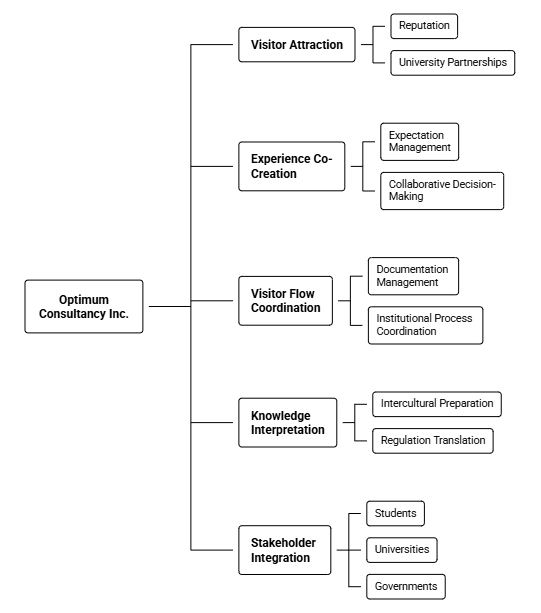
The visitor economy increasingly encompasses forms of temporary mobility beyond conventional tourism, yet international student mobility remains comparatively underrepresented despite its economic, social, cultural, and knowledge-based contributions to destinations. Previous visitor economy research has focused mainly on leisure, business, and event visitors, while international education research has rarely examined student mobility through a visitor economy lens. This study aims to extends the visitor economy framework to international student mobility by examining the intermediary role of Optimum Consultancy Inc. (OCI), Bangladesh, and asks how consultancy activities shape mobility, visitor experience, and stakeholder coordination. The study uses a qualitative single-case study design based on semi-structured online interviews with 20 participants across five stakeholder groups, supported by secondary academic and documentary sources and analysed through analytical generalisation and conceptual mapping. The findings show that OCI performs strategic intermediary functions by reducing information asymmetry and perceived risk, coordinating administrative and stakeholder flows, interpreting complex institutional information, and co-creating visitor experiences before physical travel. The analysis further identifies consultancy services as intangible attractions and positions consultancy firms as actors that extend visitor management beyond destination boundaries and into pre-mobility processes. The study contributes theoretically by integrating visitor economy, experience economy, visitor management, stakeholder, and international student mobility perspectives into an extended framework. Practically, the framework offers guidance for education consultancies, higher education institutions, destination managers, and policymakers seeking to improve international student experiences and strengthen the economic and social value of educational mobility.
References
Albrecht, J. N., & Raymond, E. (2021). National destination pledges: Visitor management through emotional engagement, commitment and interpretation. Tourism Management Perspectives, 40, 100894. https://doi.org/10.1016/j.tmp.2021.100894
Alpek, L. B., Császár, Z. M., Tóth, Á. D., & Czimre, K. (2022). Impacts of the international students’ consumption expenditures on the national economy in Hungary, 2020. Regional Statistics, 12(4), 176–199. https://doi.org/10.15196/RS120408
Altbach, P. G., & Knight, J. (2007). The internationalization of higher education: Motivations and realities. Journal of Studies in International Education, 11(3–4), 290–305. https://doi.org/10.1177/1028315307303542
Beech, S. E. (2019). The geographies of international student mobility: Spaces, places and decision-making. Palgrave Macmillan. https://doi.org/10.1007/978-981-13-7442-5
Brooks, R., Courtois, A., Faas, D., Jayadeva, S., & Beech, S. (2024). International student mobility within Europe: Responding to contemporary challenges. Higher Education, 88(5), 1663–1672. https://doi.org/10.1007/s10734-024-01222-0
Collins, F. L. (2012). Organizing student mobility: Education agents and student migration to New Zealand. Pacific Affairs, 85(1), 137–160. https://doi.org/10.5509/2012851137
Curtis, T., & Ledgerwood, J. R. (2018). Students’ motivations, perceived benefits and constraints towards study abroad and other international education opportunities. Journal of International Education in Business, 11(1), 63–78. https://doi.org/10.1108/JIEB-01-2017-0002
Dos Santos, L. M., Lo, H. F., & Kwee, C. T. T. (2024). Australia as the destination for study abroad: International students’ mobility. Heliyon, 10(23), e39741. https://doi.org/10.1016/j.heliyon.2024.e39741
Eletxigerra, A., Barrutia, J. M., & Echebarria, C. (2021). Tourist expertise and pre-travel value co-creation: Task-related processes and beyond. Tourism Management Perspectives, 37, 100772. https://doi.org/10.1016/j.tmp.2020.100772
Feng, S., & Horta, H. (2021). Brokers of international student mobility: The roles and processes of education agents in China. European Journal of Education, 56(2), 248–264. https://doi.org/10.1111/ejed.12442
Font, X., English, R., Gkritzali, A., & Tian, W. S. (2021). Value co-creation in sustainable tourism: A service-dominant logic approach. Tourism Management, 82, 104200. https://doi.org/10.1016/j.tourman.2020.104200
Freeman, R. E. (1984). Strategic management: A stakeholder approach. Pitman.
Fyall, A., Garrod, B., & Wang, Y. (Eds.). (2012). Destination collaboration: A critical review of theoretical approaches to a multi-dimensional phenomenon. Routledge.
Gunn, C. A. (1972). Vacationscape: Designing tourist regions. Bureau of Business Research, University of Texas at Austin.
Hall, C. M. (2008). Tourism planning: Policies, processes and relationships (2nd ed.). Pearson Education.
Inouye, K., Lee, S., & Oldac, Y. I. (2023). A systematic review of student agency in international higher education. Higher Education, 86(4), 891–911. https://doi.org/10.1007/s10734-022-00952-3
Jarvis, J. (2020). ‘Study in Estonia’: The strategic implications of hosting international students on Estonia’s tourism economy. Journal of Baltic Studies, 51(2), 261–274. https://doi.org/10.1080/01629778.2018.1439847
Kritz, M. (2015). International student mobility and tertiary education capacity in Africa. International Migration, 53(1), 29–49. https://doi.org/10.1111/imig.12053
Leiper, N. (1990). Tourist attraction systems. Annals of Tourism Research, 17(3), 367–384. https://doi.org/10.1016/0160-7383(90)90004-B
Luk, S. H. (2024). Education-migration brokers, international student mobilities and digital transformations in pre- and post-pandemic times. Geography Compass, 18(1), e12730. https://doi.org/10.1111/gec3.12730
Mason, P. (2015). Tourism impacts, planning and management (3rd ed.). Routledge.
Mendoza-Jiménez, J., García-Rodriguez, F. J., & García-González, C. G. (2026). International student mobility and its impact on destination countries. Fudan Journal of the Humanities and Social Sciences, 19, 277–302. https://doi.org/10.1007/s40647-025-00450-7
Moscardo, G. (1996). Mindful visitors: Heritage and tourism. Annals of Tourism Research, 23(2), 376–397. https://doi.org/10.1016/0160-7383(95)00068-2
Netz, N., Van Mol, C., Riaño, Y., & Raghuram, P. (2025). The role of place in international student mobility. Globalisation, Societies and Education, 23(4), 825–835. https://doi.org/10.1080/14767724.2024.2414036
OECD. (2020). OECD tourism trends and policies 2020. OECD Publishing. https://doi.org/10.1787/6b47b985-en
OECD. (2022). Education at a glance 2022: OECD indicators. OECD Publishing. https://doi.org/10.1787/3197152b-en
Pereira López, X., Fernández, M., & Carrascal Incera, A. (2016). The economic impact of international students in a regional economy from a tourism perspective. Tourism Economics, 22(1), 125–139. https://doi.org/10.5367/te.2014.0414
Pine, B. J., II, & Gilmore, J. H. (1999). The experience economy: Work is theatre & every business a stage. Harvard Business School Press.
Prahalad, C. K., & Ramaswamy, V. (2004). The future of competition: Co-creating unique value with customers. Harvard Business School Press.
Rather, R. A., Hollebeek, L. D., & Rasoolimanesh, S. M. (2022). First-time versus repeat tourism customer engagement, experience, and value cocreation: An empirical investigation. Journal of Travel Research, 61(3), 549–564. https://doi.org/10.1177/0047287521997572
Sohaee, N. (2023). Leveraging international student mobility to enhance the competitiveness of developing countries in the global market. In F. A. Yamoah & A. ul Haque (Eds.), Corporate management ecosystem in emerging economies (pp. 63–78). Springer. https://doi.org/10.1007/978-3-031-41578-4_5
Tilden, F. (1957). Interpreting our heritage. University of North Carolina Press.
United Nations, & World Tourism Organization. (2010). International recommendations for tourism statistics 2008. United Nations.
Universities UK International. (2023). International facts and figures 2023. Universities UK International.
Vargo, S. L., & Lusch, R. F. (2008). Service-dominant logic: Continuing the evolution. Journal of the Academy of Marketing Science, 36(1), 1–10. https://doi.org/10.1007/s11747-007-0069-6
Waters, J., & Brooks, R. (2022). Geographies of education at macro-, meso- and micro-scales: Young people and international student mobility. In L. Hammond, M. Biddulph, S. Catling, & J. H. McKendrick (Eds.), Children, education and geography: Rethinking intersections (pp. 21–35). Routledge. https://doi.org/10.4324/9781003248538-4
Xu, H., & Miller, T. (2021). International recruitment in Canadian higher education: Factors influencing students’ perceptions and experiences with education agents. Comparative and International Education, 49(2), 17–34. https://doi.org/10.5206/cieeci.v50i1.14132
Yang, Y., Lomer, S., Lim, M. A., & Mittelmeier, J. (2022). A study of Chinese students’ application to UK universities in uncertain times: From the perspective of education agents. Journal of International Students, 12(3), 565–586. https://doi.org/10.32674/jis.v12i3.3777
Yin, R. K. (2018). Case study research and applications: Design and methods (6th ed.). SAGE Publications.
Published
How to Cite
Issue
Section
License
Copyright (c) 2026 Rafiqul Bari Lasker, Ágnes Nóra Raffay-Danyi

This work is licensed under a Creative Commons Attribution-ShareAlike 4.0 International License.
Most read articles by the same author(s)
- Rafiqul Bari Lasker, Muhammad Firdaus Bin Muhammad Sabri, Strategic Recruitment and Selection Practices: Enhancing Business Performance in F&B Sector , Journal of Society Innovation and Development: Vol. 7 No. 2 (2026): JSID: May 2026
.png)

%20(4).png)
.png)
.png)
.png)


.png)
.png)
.png)