The Economics of Pain: A Conceptual Metaphor Analysis of Self-Commercialization in Ghalib’s Poetry
DOI:
https://doi.org/10.63924/jsid.v8i1.265Keywords:
Poetry, Conceptual Metaphor Theory, Mirza Ghalib, Metaphor, PragmaticsAbstract
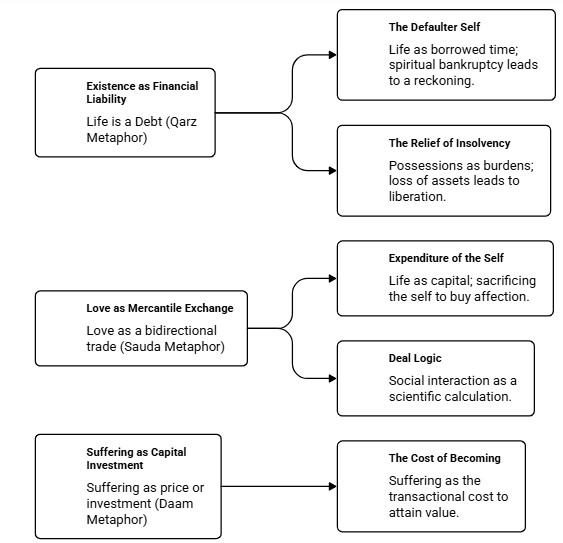
Mirza Ghalib’s canonical legacy rests almost exclusively on his Sufi mysticism and existential philosophy. Yet, the profound imprint of his lifelong financial precarity on his poetic framework remains critically under-examined. This study addresses this glaring lacuna in Urdu literary criticism by demonstrating how market rationality and mercantile metaphors fundamentally organize Ghalib’s ontology. Drawing on Lakoff and Johnson’s Cognitive Metaphor Theory, we conduct a qualitative content analysis of purposively selected verses from the Diwan-e-Ghalib, tracking specific economic lexical markers such as qarz (debt), sauda (trade/bargain), and daam (price). The analysis reveals that Ghalib constructs a "Transactional Self." Through deliberate cognitive mapping, he conceptualizes human existence not as a manifestation of divine grace, but as a perpetual state of indebtedness, while simultaneously reframing love as a system of transactional reciprocity. Ultimately, this research recasts Ghalib as an economic realist who effectively secularized the classical ghazal tradition. By displacing spiritual agency with financial anxiety, he provides a critical, historically grounded lens to examine the materialism of the self during India's transition into colonial modernity.
References
Alam, M. (2012). Mirza Ghalib and the British legacy. Journal of Subcontinent Researches, 4(11), 61–70. https://doi.org/10.22111/jsr.2012.837
Anwar, H., Wahab, Z. U., & Choudhary S. (2025). Poetic emotions in imagery: Illustrations from Dewan-e-Ghalib. Arts & Humanities Multidisciplinary Research Journal of Pakistan. http://shnakhat.com/index.php/shnakhat/article/view/178
Cameron, L. (2007). Confrontation or complementarity?: Metaphor in language use and cognitive metaphor theory. Annual Review of Cognitive Linguistics, 5, 107–135. https://doi.org/10.1075/arcl.5.06cam
Chandra, P. (2022). Thought’s occasion in Ghalib, Wordsworth, and Mallarmé: Comparative poetics after colonization. Princeton University. http://arks.princeton.edu/ark:/88435/dsp01pk02cd957
Fatihi, A. R. (2018). Conceptual blending in Ghalib’s poetry. Interdisciplinary Journal of Linguistics, 11, 29–35.
Freeman, D. C. (1997). Cognitive metaphor and literary theory: Towards the new philology. Deseret Language and Linguistic Society Symposium, 23(1), 19–28.
Gulfam, G. Q., Hasan, W., & Bhatti, A. M. (2022). Cognitive metaphor theory: A review. Jahaan e Tehqeeq, 5(2), 280–287.
Khan, D. M. A. (2019). The politics of a lover’s complaints: Loss of power as a metaphor in Ghalib’s Urdu verse. Journal of Research in Humanities, 01(55), 63–76.
Kövecses, Z. (2014). Context-induced variation in metaphor. Debreceni Egyetemi Kiadó, 10, 392–402.
Lakoff, G., & Johnson, M. (1980a). Metaphors we live by (Vol. 40). https://press.uchicago.edu/ucp/books/book/chicago/M/bo3637992.html
Lakoff, G., & Johnson, M. (1980b). The metaphorical structure of the human conceptual system. Cognitive Science, 4(2), 195–208. https://doi.org/10.1207/s15516709cog0402_4
Mehmood, K. T. (2008). Diwan-e-Ghalib selections. Star Publications. https://books.google.com.pk/books?id=cFLvs5qOZwwC
Mirza, S. M. (2019). 150 years of Mirza Ghalib: How his genius took the ghazal to new heights and depths. The Wire. https://thewire.in/books/150-years-of-mirza-ghalib-genius-ghazal
Mulmule, N. M. (2022). Mirza Ghalib: A self-actualizing poet with poetry of nihilism. Indian Journal of Psychological Medicine, 44(5), 504–509. https://doi.org/10.1177/0253717620969070
Naim, C. M. (2003). Ghalib’s Delhi a shamelessly revisionist look at two popular metaphors. The Annual of Urdu Studies, 18. http://digital.library.wisc.edu/1793/18315
Raja, M. A. (2009). The Indian rebellion of 1857 and Mirza Ghalib’s narrative of survival. Prose Studies, 31(1), 40–54. https://doi.org/10.1080/01440350903157043
Rekhta. (2025). Urdu poetry, urdu shayari of famous poets. Rekhta. https://www.rekhta.org
Romero, E., & Soria, B. (2005). Cognitive metaphor theory revisited. Jlse, 34(1), 1–20. https://doi.org/10.1515/jlse.2005.34.1.1
Romman, O. A. (2025). The theory of conceptual metaphor in cognitive linguistics. Jordan Journal of Applied Science-Humanities Series, 43(2). https://doi.org/10.35192/jjoas-h.v43i2.1182
Russell, R., & Islam, K. (1969). Ghalib, 1797-1869 Volume I: Life and letters. https://books.google.com/books/about/Ghalib_1797_1869_Life_and_letters.html?id=68xjAAAAMAAJ&redir_esc=y
Shah, M. I. & Mahrukh. (2025). Metaphysical dimensions of Mirza Ghalib’s poetry: A philosophical evaluation. Advance Social Science Archive Journal, 4(1), 48–63. https://doi.org/10.55966/assaj.2025.4.1.042
Published
How to Cite
Issue
Section
License
Copyright (c) 2026 Maaz Jamal

This work is licensed under a Creative Commons Attribution-ShareAlike 4.0 International License.
.png)

%20(4).png)
.png)
.png)
.png)


.png)
.png)
.png)