Creative Reading in Primary Schools: A Synthesis of Transactional, Sociocultural, and Multiliteracies Perspectives
DOI:
https://doi.org/10.63924/jsid.v8i1.375Keywords:
Creative Reading, Multiliteracies, Transactional Theory, Sociocultural Theory, Primary SchoolAbstract
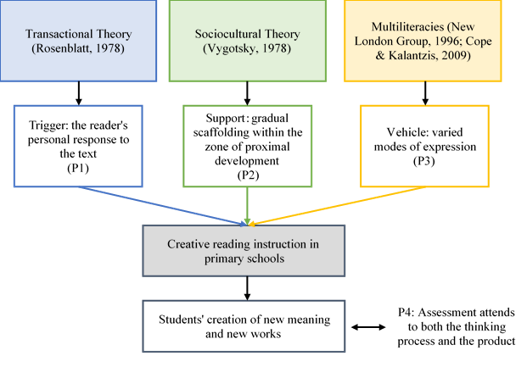
Background: Creative reading in primary schools is often reduced to literal comprehension, whereas twenty-first-century literacy demands that students interpret, transform, and design new meanings from diverse forms of text. Novelty: Existing studies tend to examine reader response, scaffolding, and multimodal expression separately, so a framework that unites them for creative reading is still lacking. Objective: This conceptual article therefore aims to synthesize Rosenblatt’s transactional theory, Vygotsky’s sociocultural theory, and the multiliteracies framework as foundations for teaching creative reading. Methodology: Using a theory synthesis approach, the study drew on literature collected from Scopus, Google Scholar, DOAJ, ERIC, and Sinta according to relevance and recency criteria, and analyzed the material through thematic coding and narrative synthesis. Key findings: The findings show that the three frameworks are complementary: Rosenblatt’s theory positions the reader’s aesthetic response as the starting point of meaning-making, Vygotsky’s theory explains the role of social interaction and scaffolding within the zone of proximal development, and multiliteracies extend the expression of meaning across multiple modes of representation. Their integration yields a conceptual framework with four propositions: opening space for personal response before analytical tasks, gradually fading teacher support, offering varied modes of post-reading expression, and assessing both thinking processes and products. Implications: Practically, the framework gives teachers a principled basis for designing creative reading lessons, and it gives researchers testable propositions. Because the framework is argumentative and has not been empirically tested, development research, classroom action research, and quasi-experiments are recommended to operationalize and test it in primary schools.
References
Abdurrahman. (2024). Metode penelitian kepustakaan dalam pendidikan Islam. Adabuna: Jurnal Pendidikan dan Pemikiran, 3(2). https://ejournal.uiidalwa.ac.id/index.php/adabuna/article/view/1563
Afifah, W., Soeharto, Budiwati, T. R., & Atmantika, Z. H. (2023). Enhancing reading abilities: Exploring the interrelationships among speed, critical, and creative reading through classroom-based action research. Lectura: Jurnal Pendidikan, 14(2). https://doi.org/10.31849/lectura.v14i2.13851
Amelia, Subrata, H., Hendratno, Purwoko, B., & Widodo, W. (2026). Integrasi multiliterasi berbasis kearifan lokal dalam pembelajaran bahasa Indonesia: Perspektif filsafat ilmu pendidikan. Literasi: Jurnal Ilmiah Pendidikan Bahasa, Sastra Indonesia dan Daerah, 16(2), 360–368. https://doi.org/10.23969/literasi.v16i2.46260
Anandari, C. L., Andriyanti, E., & Widodo, P. (2024). EFL students’ responses towards Rosen’s “Sad Book”: An attitudinal occurrence and aesthetic stance. Studies in English Language and Education, 11(1), 285–303. https://doi.org/10.24815/siele.v11i1.29725
Arguido, L. M., Felisilda, E. I., & Escarlos, G. S. (2025). Vygotsky's sociocultural theory: Elevating reading comprehension in elementary learners through the ARAL program and its implications for administration and governance in contemporary education. International Journal of Research and Innovation in Social Science, 9(10), 7991–7998. https://doi.org/10.47772/IJRISS.2025.910000656
Báez-Bargellini, G., & Meneses-Arévalo, A. (2023). Multiliteracy in language subjects: A systematic literature review from 1996 to 2020. Ocnos, 22(2). https://doi.org/10.15304/ocnos_22.2.346
Braun, V., & Clarke, V. (2006). Using thematic analysis in psychology. Qualitative Research in Psychology, 3(2), 77–101. https://doi.org/10.1191/1478088706qp063oa
Braun, V., & Clarke, V. (2021). One size fits all? What counts as quality practice in (reflexive) thematic analysis? Qualitative Research in Psychology, 18(3), 328–352. https://doi.org/10.1080/14780887.2020.1769238
Byrne, D. (2022). A worked example of Braun and Clarke’s approach to reflexive thematic analysis. Quality & Quantity, 56(3), 1391–1412. https://doi.org/10.1007/s11135-021-01182-y
Cope, B., & Kalantzis, M. (2009). "Multiliteracies": New literacies, new learning. Pedagogies: An International Journal, 4(3), 164–195. https://doi.org/10.1080/15544800903076044
Cronin, M. A., & George, E. (2023). The why and how of the integrative review. Organizational Research Methods, 26(1), 168–192. https://doi.org/10.1177/109442812093550
Fatmawati, N. (2025). Urgensi literasi digital dalam meningkatkan keterampilan abad 21 di sekolah dasar: Kajian literatur dan strategi implementasi. Social, Humanities, and Educational Studies (SHES): Conference Series, 8(3), 1483–1490. https://doi.org/10.20961/shes.v8i3.107405
Fauzi, W. N. A., Wuryandani, W., & Supartinah. (2025). Creative thinking in global primary education: Pedagogical innovations and learning outcomes through an integrated bibliometric and systematic review. Social Sciences & Humanities Open, 12, 102216. https://doi.org/10.1016/j.ssaho.2025.102216
Fudhaily, A. W., Damaianti, V. S., Sunendar, D., & Mulyasari, E. (2026). Analisis kebutuhan dalam pembelajaran membaca kreatif berbasis multiliterasi di sekolah dasar: Perspektif guru dan siswa. Jurnal Ilmu Pendidikan Dasar Indonesia, 5(3), 605–622. https://doi.org/10.51574/judikdas.v5i3.5897
Fudhaily, A. W., & Rahman. (2022). The impact of the multiliteration learning model on the ability to read comprehension and creative writing of fifth grade elementary school students. MIMBAR PGSD Undiksha, 10(2), 424–430. https://doi.org/10.23887/jjpgsd.v10i2.46749
Gillon, G., McNeill, B., Scott, A., Gath, M., Macfarlane, A., & Taleni, T. (2024). Large scale implementation of effective early literacy instruction. Frontiers in Education, 9. https://doi.org/10.3389/feduc.2024.1354182
Grandits, P., & Krek, J. (2023). High school students’ attentional stance, modes of reading engagement, and self-insight during literary reading. L1-Educational Studies in Language and Literature, 23, 1–28. https://doi.org/10.21248/l1esll.2023.23.1.485
Grant, M. J., & Booth, A. (2009). A typology of reviews: An analysis of 14 review types and associated methodologies. Health Information & Libraries Journal, 26(2), 91–108. https://doi.org/10.1111/j.1471-1842.2009.00848.x
Harrison, D., & Linares, R. E. (2023). Engaging elementary students beyond the text through multimodal critical literacy. Language Arts, 100(6). https://doi.org/10.58680/la202332542
Heinonen, K., & Gruen, T. (2024). Elevating conceptual research: Insights, approaches, and support. AMS Review, 14(1), 1–6. https://doi.org/10.1007/s13162-024-00283-9
Jaakkola, E. (2020). Designing conceptual articles: Four approaches. AMS Review, 10(1), 18–26. https://doi.org/10.1007/s13162-020-00161-0
Jayanti, E. D., & Damayanti, I. L. (2023). Exploring teachers' perceptions of integrating multimodal literacy into English classrooms in Indonesian primary education. Child Education Journal, 5(2), 98–109. https://doi.org/10.33086/cej.v5i2.5240
Kamlun, K., Din, W. A., & Swanto, S. (2026). The aesthetic transaction in L2 literary reading: Self-involvement and literary judgment among Malaysian student teachers. International Journal of Research and Innovation in Social Science, 10(26), 386–397. https://doi.org/10.47772/IJRISS.2026.1026EDU0029
Khairani, P., Trianton, T., & Sari, S. (2025). Peningkatan kemampuan menulis cerita berdasarkan pengalaman melalui media gambar pada siswa kelas IV SD 098021 Kampung Prapat tahun pembelajaran 2024-2025. Pendas: Jurnal Ilmiah Pendidikan Dasar, 10(1), 231–245. https://doi.org/10.23969/jp.v10i01.23442
Kushki, A. (2024). L2 reading assessment from a sociocultural theory perspective. Education Sciences, 14(4), 342. https://doi.org/10.3390/educsci14040342
Kusumaningrum, S. R., Dewi, R. S. I., Mardhatillah, M., Pristiani, R., Rizal, M. S., & Mustakim, S. S. (2024). Multimodal texts implementation in Indonesian primary and secondary EFL classrooms: Prospects and challenges. Jurnal Pendidikan Progresif, 14(3), 1475–1488. https://doi.org/10.23960/jpp.v14.i3.2024102
Lestari, K. I. D., Wahyuni, K. A., Triarsitadewi, I. A. I., Sartika, K. H. D., Setiawidiantari, K. D., & Werang, B. R. (2024). Implementasi Gerakan Literasi Sekolah dan pengaruhnya terhadap kemampuan membaca pemahaman siswa kelas V sekolah dasar. Jurnal Basicedu, 8(3), 2153–2164. https://doi.org/10.31004/basicedu.v8i3.7794
Lim, F. V. (2023). A design-based research approach to the teaching and learning of multiliteracies. The Asia-Pacific Education Researcher, 32(5), 641–653. https://doi.org/10.1007/s40299-022-00683-0
Long, H., Kerr, B. A., Emler, T. E., & Birdnow, M. (2022). A critical review of assessments of creativity in education. Review of Research in Education, 46(1), 288–323. https://doi.org/10.3102/0091732X221084326
Maamuujav, U. (2025). Multimodal writing in multilingual space. Education Sciences, 15(11), 1446. https://doi.org/10.3390/educsci15111446
MacInnis, D. J. (2011). A framework for conceptual contributions in marketing. Journal of Marketing, 75(4), 136–154. https://doi.org/10.1509/jmkg.75.4.136
Mardi, M., Putri, D. E., Yasmanelly, Naini, I., & Gusnetti. (2025). Peningkatan literasi sastra siswa sekolah dasar melalui media digital dan pendekatan kontekstual. Edu Cendikia: Jurnal Ilmiah Kependidikan, 5(2). https://doi.org/10.47709/educendikia.v5i02.6408
Maryam, A. M., Septiani, N. D., & Nasution, F. (2026). Penerapan zone of proximal development dan scaffolding dalam meningkatkan efektivitas pembelajaran siswa. Jurnal Pendidikan Tambusai, 10(2), 17498–17507. https://doi.org/10.31004/jptam.v10i2.40878
Masrurah, U., Rahmawati, F. P., & Ghufron, A. (2024). Implementasi Kurikulum Merdeka dalam peningkatan literasi peserta didik di sekolah dasar. Pendas: Jurnal Ilmiah Pendidikan Dasar, 9(4), 340–356. https://doi.org/10.23969/jp.v9i4.16906
Mendhakar, A., Płużyczka, M., & Leder, H. (2025). Effects of graphic organizers on aesthetic reading experience. Frontiers in Language Sciences, 4. https://doi.org/10.3389/flang.2025.1472429
Mirra, N., & Garcia, A. (2021). In search of the meaning and purpose of 21st-century literacy learning: A critical review of research and practice. Reading Research Quarterly, 56(3), 463–496. https://doi.org/10.1002/rrq.313
Momeni, S. M., Aerila, J.-A., & Routarinne, S. (2026). Classroom applications of the reader-response approach in primary and secondary education: A systematic review (1989–2024). L1-Educational Studies in Language and Literature, 26(1), 1–39. https://doi.org/10.21248/l1esll.2026.26.1.962
New London Group. (1996). A pedagogy of multiliteracies: Designing social futures. Harvard Educational Review, 66(1), 60–92. https://doi.org/10.17763/haer.66.1.17370n67v22j160u
Noeraeni, R., Munawaroh, E., Masruri, M., Wijaya, N. R. Y., & Rasuki, R. (2025). Pengembangan literasi membaca: Strategi meningkatkan minat baca siswa. JIP: Jurnal Ilmu Pendidikan, 3(4), 194–203. https://jutepe-joln.net/index.php/JURDIKAN/article/view/57
Nurajijah, Z., Saputra, D. S., & Damayanti, I. (2026). Analisis literatur sistematis tentang penggunaan buku cerita fabel berbasis multimode untuk meningkatkan keterampilan membaca kreatif teks fabel pada siswa sekolah dasar. Pendas: Jurnal Ilmiah Pendidikan Dasar, 11(3), 341–355. https://doi.org/10.23969/jp.v11i03.62192
Nuroh, E. Z., & Fatikhasari, N. A. (2025). Implementasi pembelajaran multiliterasi pedagogik di sekolah dasar. Publikasi Pendidikan, 15(2), 429–440. https://doi.org/10.70713/publikan.v15i2.71554
OECD. (2026). PISA 2025 results: Indonesia country note. OECD Publishing.
Page, M. J., McKenzie, J. E., Bossuyt, P. M., Boutron, I., Hoffmann, T. C., Mulrow, C. D., Shamseer, L., Tetzlaff, J. M., Akl, E. A., Brennan, S. E., Chou, R., Glanville, J., Grimshaw, J. M., Hróbjartsson, A., Lalu, M. M., Li, T., Loder, E. W., Mayo-Wilson, E., McDonald, S., … Moher, D. (2021). The PRISMA 2020 statement: An updated guideline for reporting systematic reviews. BMJ, 372, n71. https://doi.org/10.1136/bmj.n71
Paul, J., Khatri, P., & Duggal, H. K. (2024). Frameworks for developing impactful systematic literature reviews and theory building: What, why and how? Journal of Decision Systems, 33(4), 537–550. https://doi.org/10.1080/12460125.2023.2197700
Raihan, S. (2024). Efektivitas pembelajaran multiliterasi terhadap kemampuan literasi siswa sekolah dasar. Pendas: Jurnal Ilmiah Pendidikan Dasar, 9(2), 4717–4727. https://doi.org/10.23969/jp.v9i2.14264
Rigopouli, K., Kotsifakos, D., & Psaromiligkos, Y. (2025). Vygotsky's creativity options and ideas in 21st-century technology-enhanced learning design. Education Sciences, 15(2), 257. https://doi.org/10.3390/educsci15020257
Rosenblatt, L. M. (1978). The reader, the text, the poem: The transactional theory of the literary work. Southern Illinois University Press.
Saputra, D. K., Ramadhani, M. H., Salsabila, R. A., Putri, D. N., & Zamri, H. A. U. (2026). Kemampuan membaca kreatif dalam apresiasi karya sastra siswa SMP. Journal of Innovative and Creativity (Joecy), 6(2), 29831–29841. https://doi.org/10.31004/joecy.v6i2.10902
Saputra, D. T., Rahmawati, L. E., & Markhamah. (2025). Implementation strategy of multimodal literacy text as a means to optimize literacy in Indonesian language lessons for elementary school students. Bahastra, 45(1), 155–164. https://doi.org/10.26555/bs.v45i1.1260
Selayani, N. K., & Bayu, G. W. (2023). Pembelajaran berbasis multiliterasi di sekolah dasar: Bagaimana mengoptimalkannya? Jurnal Ilmiah Pendidikan Profesi Guru, 5(3), 466–478. https://doi.org/10.23887/jippg.v5i3.57400
Snyder, H. (2019). Literature review as a research methodology: An overview and guidelines. Journal of Business Research, 104, 333–339. https://doi.org/10.1016/j.jbusres.2019.07.039
Suryani, D. A., & Fauzi. (2025). Meningkatkan kemampuan literasi dengan pendekatan teori Vygotsky anak sekolah dasar. Pendas: Jurnal Ilmiah Pendidikan Dasar, 10(4), 347–361. https://doi.org/10.23969/jp.v10i04.38404
Tinggie, T. L. G., Tan, K. H., Muslim, N., & Lim, K. K. (2023). Peer scaffolding among primary ESL learners' writing task: Learners' behaviors and triggering factors. International Journal of Learning, Teaching and Educational Research, 22(3), 191–208. https://doi.org/10.26803/ijlter.22.3.12
Vygotsky, L. S. (1978). Mind in society: The development of higher psychological processes. Harvard University Press.
World Bank. (2025, October 30). New report offers evidence-based solutions to address global literacy crisis among children [Press release]. https://www.worldbank.org/en/news/press-release/2025/10/30/new-report-offers-evidence-based-solutions-to-address-global-literacy-crisis-among-children
World Bank, UNESCO, & UNICEF. (2022). The state of global learning poverty: 2022 update. World Bank.
Wu, L., & Abu Bakar, K. (2025). Language scaffolding strategies based on Vygotsky's zone of proximal development in early reading education: A cross-cultural comparison. Forum for Linguistic Studies, 7(6), 967–984. https://doi.org/10.30564/fls.v7i6.9624
Zuhri, S., Suwindia, I. G., & Winangun, I. M. A. (2024). Literasi digital dan kecakapan abad ke-21: Analisis komprehensif dari literatur terkini. Education and Social Sciences Review, 5(2), 149–155. https://doi.org/10.29210/07essr500300
Published
How to Cite
Issue
Section
License
Copyright (c) 2026 Ahmad Wahid Fudhaily, Vismaia S. Damaianti, Dadang Sunendar, Effy Mulyasari, Panca Lumbantobing

This work is licensed under a Creative Commons Attribution-ShareAlike 4.0 International License.