Navigating Fiscal Austerity: Budget Efficiency and Public Service Delivery in Subnational Governance
DOI:
https://doi.org/10.63924/jsid.v8i1.372Keywords:
Fiscal Austerity, Budget Efficiency, Policy Implementation, Organizational Adaptation, Public Service DeliveryAbstract
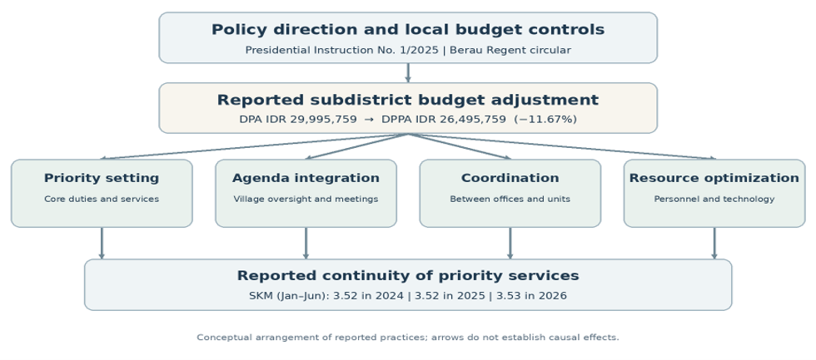
Indonesia's 2025 fiscal austerity policy required subnational administrations to restrain expenditure while maintaining essential public services. This study examined how the Government Administration and Public Service Program in Gunung Tabur Subdistrict, Berau Regency, implemented spending-efficiency directives and identified enabling and constraining conditions. Using a descriptive qualitative design, the study analyzed retrospective interviews conducted in June 2026, observations, and administrative documents through Van Meter and Van Horn's six implementation variables, with SWOT used as a supplementary synthesis. The allocation for one public-service sub activity declined from IDR 29,995,759 to IDR 26,495,759 (11.67%). Officials reported prioritizing activities, consolidating village visits, coordinating units across, and using existing facilities. Aggregate Public Satisfaction Survey scores for January–June were 3.52 in both 2024 and 2025 and 3.53 in 2026. These figures provided limited context for reported service continuity but did not establish unchanged service quality or improved cost efficiency. The findings highlighted organizational adaptation as a reported mechanism through which a subdistrict translated fiscal directives into administrative routines without formal restructuring. Given the retrospective evidence and limited service-output and cost data, the study could not establish causal effects on service performance. It underscored the need to monitor realized expenditure, service outputs, and accessibility alongside budget adjustments.
References
Ahmed, S. K. (2024). The pillars of trustworthiness in qualitative research. Journal of Medicine, Surgery, and Public Health, 2, 1–4. https://doi.org/10.1016/j.glmedi.2024.100051
Akbar, D. S., Rudiana, I. F., Prawiranegara, B., & Aryanti, M. (2022). Assessing the effectiveness and efficiency of the public service budget: A study in one region in Indonesia. Jurnal Ilmiah Akuntansi Kesatuan, 10(1), 37–46. https://doi.org/10.37641/jiakes.v10i1.1189
Bingham, A. J. (2023). From data management to actionable findings: A five-phase process of qualitative data analysis. International Journal of Qualitative Methods, 22, 16094069231183620. https://doi.org/10.1177/16094069231183620
Brodkin, E. Z. (2011). Policy work: Street-level organizations under new managerialism. Journal of Public Administration Research and Theory, 21(suppl_2), i253–i277. https://doi.org/10.1093/jopart/muq093
Chang, A., & Brewer, G. A. (2023). Street-Level bureaucracy in public administration: A systematic literature review. Public Management Review, 25(11), 2191–2211. https://doi.org/10.1080/14719037.2022.2065517
Creswell, J. W., & Poth, C. N. (2018). Qualitative Inquiry and Research Design: Choosing Among Five Approaches (4th ed.). In SAGE Publications. https://books.google.co.id/books?id=DLbBDQAAQBAJ
Hakim, A., Fauzi, A. R., & Yacinta Stefila Paramawati. (2025). Local Government Strategies in Maintaining the Quality of Public Services Following Budget Efficiency Policies: A Study of the Mojokerto Regency Government, Bekasi City Government, and Blora Regency Government. JURNAL SAINS SOSIAL DAN HUMANIORA (JSSH), 5(1), 147–159. https://doi.org/10.52046/jssh.v5i1.2645
Handayani, N., Nurmayanti, D. R., & Nugroho, R. (2021). Implementasi Kebijakan Pelayanan Administrasi Terpadu Kecamatan (PATEN) di Kecamatan Kalijati Kabupaten Subang Provinsi Jawa Barat. Jurnal Kebijakan Pemerintahan, 4(1), 32–40. https://doi.org/10.33701/jkp.v4i1.1564
Hartono, H. (2025). Urgensi Instruksi Presiden Nomor 01 Tahun 2025 terhadap pelaksanaan APBN di Kementerian/Lembaga Tahun 2025. Indonesian Research Journal on Education, 5(1). https://garuda.kemdiktisaintek.go.id/documents/detail/5070055
Hupe, P., & Hill, M. (2007). Street-level bureaucracy and public accountability. Public Administration, 85(2), 279–299. https://doi.org/10.1111/j.1467-9299.2007.00650.x
Kecamatan Gunung Tabur. (2026). Kecamatan Gunung Tabur Kabupaten Berau. In Situs Resmi Kecamatan Gunung Tabur. Pemerintah Kabupaten Berau. https://kec-gunungtabur.beraukab.go.id/profil
Kementerian Pendayagunaan Aparatur Negara dan Reformasi Birokrasi RI. (2017). Peraturan Menteri PANRB Nomor 14 Tahun 2017 tentang Pedoman Penyusunan Survei Kepuasan Masyarakat Unit Penyelenggara Pelayanan Publik. https://peraturan.bpk.go.id/Details/132600/permen-pan-rb-no-14-tahun-2017
Koeswara, H., Aromatica, D., Tomimi, Z. M., Liesmana, R., Kabullah, M. I., Puri, W. P., & Tjenreng, M. Z. B. (2025). Capacity of Local Government Policy in Implementing Minimum Service Standards. Journal Public Policy, 11(3), 327–334. https://doi.org/10.35308/jpp.v11i3.12445
Lipsky, M. (1980). Street-level bureaucracy: Dilemmas of the individual in public services. https://www.russellsage.org/publications/book/street-level-bureaucracy
Marthalina, M., Dione, F., & Saribulan, N. (2025). Determining Factors of Digital Public Service Management Implementation Policy at Subdistrict Level in South Jakarta City. Jurnal Manajemen Pelayanan Publik, 9(2), 251–275. https://doi.org/10.24198/jmpp.v9i2.59855
Matland, R. E. (1995). Synthesizing the implementation literature: The ambiguity-conflict model of policy implementation. Journal of Public Administration Research and Theory, 5(2), 145–174.
Maulani, S. A., Suhartini, E., & Saprudin, S. (2026). Implementation of Budget Efficiency Policy in Realizing Good Governance at the Regional Secretariat of Bogor Regency. International Journal of Science, Engineering and Technology (IJSOC), 1(1), 1–6. https://doi.org/10.54783/ijsoc.v8i1.1599
Mergel, I., Edelmann, N., & Haug, N. (2019). Defining digital transformation: Results from expert interviews. Government Information Quarterly, 36(4), 101385. https://doi.org/10.1016/j.giq.2019.06.002
Miles, M. B., Huberman, A. M., & Saldana, J. (2014). Qualitative Data Analysis: A Methods Sourcebook (3nd ed.). Sage Publications, Inc.
Mustika, M., Afdillah, W., Sartika, R., & Pangestoeti, W. (2025). Transparansi anggaran publik dan implikasinya terhadap efisiensi pengeluaran pemerintah daerah. Jurnal Ilmu Komunikasi Dan Sosial Politik, 2(4), 1245–1250. https://doi.org/10.62379/jiksp.v2i4.2881
Nowell, L. S., Norris, J. M., White, D. E., & Moules, N. J. (2017). Thematic analysis: Striving to meet the trustworthiness criteria. International Journal of Qualitative Methods, 16(1), 1–13. https://doi.org/10.1177/1609406917733847
Overmans, J. F. A., & Noordegraaf, M. (2014). Managing austerity: Rhetorical and real responses to fiscal stress in local government. Public Money & Management, 34(2), 99–106. https://doi.org/10.1080/09540962.2014.887517
Pemerintah Republik Indonesia. (2025). Instruksi Presiden Republik Indonesia Nomor 1 Tahun 2025 tentang Efisiensi Belanja dalam Pelaksanaan APBN dan APBD Tahun Anggaran 2025. https://jdih.kemenkeu.go.id/dok/inpres-1-tahun-2025/overview
Sampar, & Hasanudding, S. (2025). Analisis implementasi kebijakan desentralisasi dalam peningkatan pelayanan publik di pemerintah daerah. Jurnal Kolaboratif Sains, 8(9), 5762–5773. https://doi.org/10.56338/jks.v8i9.8564
Setiawan, A., Tjiptoherijanto, P., Mahi, B. R., & Khoirunurrofik, K. (2022). The Impact of Local Government Capacity on Public Service Delivery: Lessons Learned from Decentralized Indonesia. In Economies (Vol. 10, Issue 12, p. 323). https://doi.org/10.3390/economies10120323
Tummers, L. (2011). Explaining the willingness of public professionals to implement new policies: A policy alienation framework. International Review of Administrative Sciences, 77(3), 555–581. https://doi.org/10.1177/0020852311407364
Utama, M. R., Widodo, S., & Putra, R. (2026). ASN Willingness in Policy Implementation: A Study of Core Values and Motivation. Jurnal Aristo (Social, Politic, Humaniora), 14(1), 62–81.
Van Meter, D. S., & Van Horn, C. E. (1975). The policy implementation process: A conceptual framework. Administration & Society, 6(4), 445–488. https://doi.org/10.1177/009539977500600404
Villamin, P., Lopez, V., Thapa, D. K., & Cleary, M. (2025). A worked example of qualitative descriptive design: A step‐by‐step guide for novice and early career researchers. Journal of Advanced Nursing, 81(8), 5181–5195. https://doi.org/10.1111/jan.16481
Wartiningsih, D., & Mulyadi, A. (2023). Implementasi kebijakan pelayanan administrasi terpadu (PATEN) pada Kecamatan Wonosalam Kabupaten Demak Tahun 2023. Gema Eksos. https://e-jurnal.unisfat.ac.id/index.php/gemaeksos/article/download/52/25
Wulandari, A., Fatimah, S., & Fitrisia, A. (2025). Efisiensi anggaran pemerintah daerah dalam perspektif filsafat ilmu: Sebuah kajian literatur. Jurnal Administrasi Pemerintahan Desa, 7(1). https://doi.org/10.47134/villages.v7i1.367
Zein, A. W., Anggraini, D., & Malau, R. A. (2025). Peran digitalisasi dalam efisiensi pelayanan publik: Studi ekonomi publik digital. Jurnal Inovasi Manajemen, Kewirausahaan, Bisnis Dan Digital, 2(2), 136–147. https://doi.org/10.61132/jimakebidi.v2i2.525
Published
How to Cite
Issue
Section
License
Copyright (c) 2026 Gilang Agiel Dananjaya, Imam Syahid, Muhammad Jamal, Hashfi Rafdi

This work is licensed under a Creative Commons Attribution-ShareAlike 4.0 International License.
Most read articles by the same author(s)
- Muhammad Agung Saputra, Imam Syahid, Mohammad Taufik, Reksa Burhan, Resource-Rich Regionalism and Candidate Branding: Political Marketing in the 2024 East Kalimantan Gubernatorial Election , Journal of Society Innovation and Development: Vol. 8 No. 1 (2026): JSID: November 2026