Arabic Writing Skills and the Imla’ Method: A Systematic Review of Dictation Pedagogy in Language Learning
DOI:
https://doi.org/10.63924/jsid.v8i1.313Keywords:
Arabic Writing Skills, Imla’ Method, Auditory Dictation, Systematic Review, Orthographic AccuracyAbstract
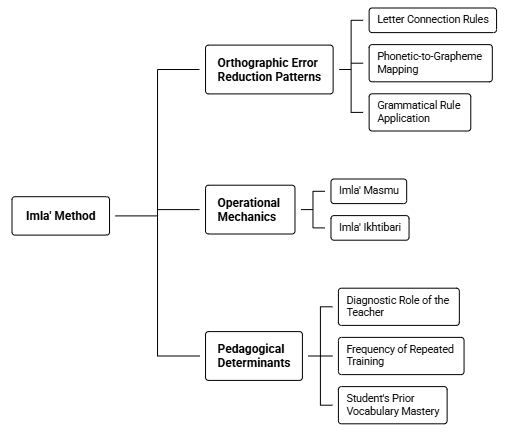
Arabic writing proficiency (maharah kitabah) remains a persistent challenge in second language acquisition due to the intricate cognitive demands of orthographic accuracy, morphological arrangement, and syntactic rules. While dictation (imla’) is traditionally utilized to mitigate these difficulties, a comprehensive synthesis of its empirical efficacy across varying educational tiers remains scarce. This systematic literature review evaluates the pedagogical impact and structural outcomes of implementing the imla’ method to enhance Arabic writing skills. Adopting a rigorous methodology, this study synthesized empirical literature indexed in major academic databases between 2021 and 2025. The thematic synthesis reveals that imla’ strategies exert a robust positive effect on maharah kitabah. Specifically, imla’ masmu’ (auditory dictation) and imla’ ikhtibari (test dictation) significantly enhance phoneme-to-grapheme mapping, sentence structure accuracy, and orthographic error reduction, while concurrently bolstering auditory working memory. Furthermore, the review identifies that the optimization of this method is heavily contingent upon strategic teacher scaffolding, sustained longitudinal practice, and learners' prior vocabulary thresholds. Crucially, the data reveals that basic orthographic errors remain stubborn and persist into secondary education if left uncorrected early on. These insights provide a critical framework for educators, implying that imla’ should be systematically integrated into modern Arabic curricula as a foundational, cognitively grounded pedagogical tool rather than a passive assessment mechanism.
References
Anugrah, I. D., Jalaludin, A., & Azis, T. N. (2024). Implementasi metode imla untuk meningkatkan efisiensi penulisan tata bahasa Arab di kelas V MIS Darunnajah Cipining [Implementation of the imla method to improve the efficiency of Arabic grammar writing in grade V of MIS Darunnajah Cipining]. Jurnal Pendidikan Bahasa Arab, 6(1), 45–58.
Azizah, A. (2022). Penerapan metode imla’ al-ikhtibari dalam meningkatkan kompetensi menulis bahasa Arab pada siswa kelas X Dayah Terpadu Al-Muslimun [Application of the imla’ al-ikhtibari method in improving Arabic writing competence among tenth grade students at Dayah Terpadu Al-Muslimun]. Jurnal Pendidikan, 14(2), 112–125.
Fadhilah, A. N. (2020). Keterampilan menulis bahasa Arab siswa kelas VII [Arabic writing skills of seventh grade students]. Jurnal Pembelajaran Bahasa Arab, 4(1), 23–36.
Gejlig, W., & Pekalongan, K. (2024). Implementasi metode imla’ dalam pembelajaran maharah kitabah di kelas VII MTs Al Utsmani Winong Gejlig Kajen Pekalongan [Implementation of the imla’ method in learning maharah kitabah in grade VII of MTs Al Utsmani Winong Gejlig Kajen Pekalongan]. Jurnal Pendidikan, 16(1), 89–102.
Khafidh, M. (2016). Implementasi metode imla’ sebagai peningkatan kemampuan menulis pada mata pelajaran bahasa arab kelas VII SMP IT Abu Bakar Umbulharjo Yogyakarta [Implementation of the imla’ method as an improvement of writing ability in Arabic subjects for grade VII of SMP IT Abu Bakar Umbulharjo Yogyakarta] (Unpublished undergraduate thesis). Universitas Islam Negeri Sunan Kalijaga, Yogyakarta.
Kraus, S., Breier, M., & Dasí-Rodríguez, S. (2020). The art of crafting a systematic literature review in entrepreneurship research. International Entrepreneurship and Management Journal, 16(3), 1023–1042. https://doi.org/10.1007/s11365-020-00635-4
Putri, A. N., Fatimah, K., Triyanto, V., & Maharani, S. (2025). Implementasi metode imla’ dalam pembelajaran bahasa Arab untuk mengembangkan maharah kitābah pada siswa kelas VII di MTsN Semarang [Implementation of the imla’ method in Arabic language learning to develop maharah kitābah among grade VII students at MTsN Semarang]. Jurnal Pendidikan Bahasa Arab, 7(2), 277–290.
Rathomi, A. (2024). Pengaruh metode imla’ untuk meningkatkan maharah kitabah siswa kelas VII MTs Masyariqul Anwar Caringin [The influence of the imla’ method to improve maharah kitabah of grade VII students at MTs Masyariqul Anwar Caringin]. Jurnal Pendidikan, 16(2), 143–156.
Sida, A. N. A., Amin, N., & Malla, A. B. (2022). Penerapan metode imla’ terhadap kemampuan menulis bahasa Arab siswa MA As’adiyah Makassar [Application of the imla’ method on the Arabic writing ability of MA As’adiyah Makassar students]. Jurnal Pendidikan, 14(1), 67–80.
Syafa’ah, N. (2024). Implementasi metode imla’ dalam pembelajaran maharah kitabah siswa kelas X SMA Hasyim As’ari Kota Pekalongan [Implementation of the imla’ method in learning maharah kitabah for tenth grade students of SMA Hasyim As’ari Pekalongan City]. Jurnal Pendidikan, 16(1), 201–214.
Zain, L. S. F., Marzuki, A., & Mustofa, D. R. (2021). Pengaruh metode imla’ terhadap kemampuan maharatul kitabah siswa kelas VI MI Nurul Hidayah Roworejo Kecamatan Negerikaton [The effect of the imla’ method on the maharatul kitabah ability of grade VI students at MI Nurul Hidayah Roworejo, Negerikaton District]. Jurnal Pendidikan, 13(2), 175–188.
Zuhriyah, N., Rahman, A., & Izzatunnisa, I. (2022). Penerapan metode imla’ istima’i dan ikhtibari untuk meningkatkan kemampuan menulis bahasa Arab MAN 2 Bima [Application of imla’ istima’i and ikhtibari methods to improve Arabic writing ability at MAN 2 Bima]. Jurnal Pendidikan, 14(2), 215–228.
Published
How to Cite
Issue
Section
License
Copyright (c) 2026 Feni Zumara, Mukhlisah Mukhlisah

This work is licensed under a Creative Commons Attribution-ShareAlike 4.0 International License.
.png)

%20(4).png)
.png)
.png)
.png)


.png)
.png)
.png)