Teaching English to Young Learners: Insights from Second Language Acquisition Theory
DOI:
https://doi.org/10.63924/jsid.v8i1.280Keywords:
Early Childhood Education, Second Language Acquisition, English Language Teaching, Young Learners, Language DevelopmentAbstract
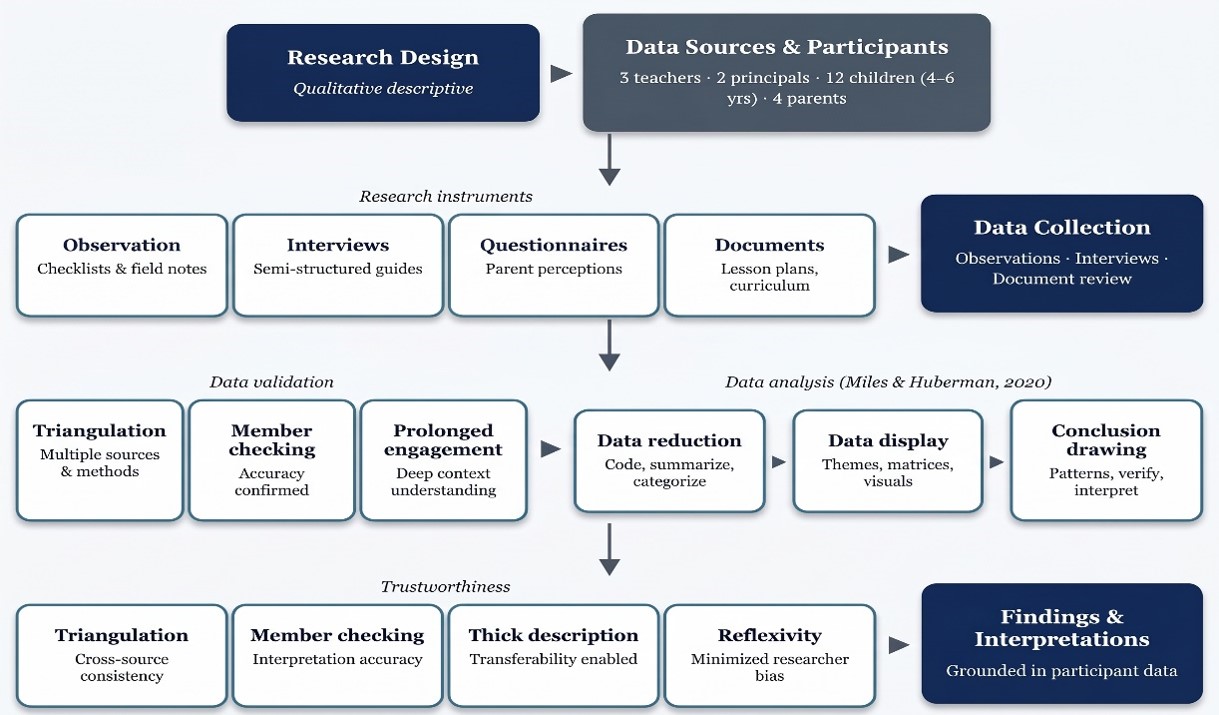
Early childhood is widely recognized as a critical period for language development; however, the implementation of English instruction at this level remains inconsistent, particularly in contexts with limited resources and insufficient teacher preparation. This gap highlights the need for a deeper understanding of how early English education is practiced and its impact on young learners. Therefore, this study aims to examine the importance of introducing English to young learners by exploring its benefits, instructional practices, and associated challenges in early childhood education. This study employed a descriptive qualitative approach, utilizing classroom observations, semi-structured interviews, and document analysis to investigate teaching practices and learner responses in an early childhood education setting. The findings indicate that early exposure to English significantly enhances children’s vocabulary acquisition, pronunciation, and language awareness. Additionally, it contributes to broader developmental aspects, including cognitive growth, memory, and social interaction. The study also reveals that interactive and engaging teaching methods such as Total Physical Response (TPR), songs, storytelling, games, and visual media are highly effective in promoting student engagement and retention. However, several challenges persist, including limited teacher expertise in Teaching English to Young Learners (TEYL), inadequate instructional materials, and insufficient parental involvement. These findings imply that the successful implementation of early English instruction requires a comprehensive approach, including continuous teacher professional development, improved access to learning resources, and strengthened collaboration between schools and families. Overall, early English education plays a crucial role in equipping children with essential language and communication skills for future academic success and global participation.
References
Abello-Contesse, C. (2009). Age and the critical period hypothesis. ELT Journal, 63(2), 170–172. https://doi.org/10.1093/elt/ccn072
Amin, M., Tsaqiila, T. Q., Zamzam, A., & Arfah, H. (2023). The earlier, the better: Global and Indonesian views on TEYL (Teaching English to Young Learners). Voices of English Language Education Society, 7(1). https://doi.org/10.29408/veles.v7i1.12403
Bialystok, E. (2001). Bilingualism in development: Language, literacy, and cognition. Cambridge University Press. https://doi.org/10.1093/elt/ccn072.
Birdsong, D. (2006). Age and second language acquisition and processing: A selective overview. Language Learning, 56(1), 9–49. https://doi.org/10.1111/j.1467-9922.2006.00353.x
Brewster, J., Ellis, G., & Girard, D. (2002). The primary English teacher’s guide. Pearson Education. https://doi.org/10.1093/elt/57.4.411
Butler, Y. G. (2021). The implementation of early English education in EFL contexts: Policy and practice. TESOL Quarterly, 55(3), 1–25. https://doi.org/10.1002/tesq.148
Cameron, L. (2001). Teaching languages to young learners. Cambridge University Press. http://dx.doi.org/10.1017/CBO9780511733109
Copland, F., Garton, S., & Burns, A. (2020). Challenges in teaching English to young learners: Global perspectives. TESOL Quarterly, 54(2), 1–12. https://doi.org/10.1002/tesq.148
Creswell, J. W. (2021). Research design: Qualitative, quantitative, and mixed methods approach (4th ed.). SAGE Publications. https://doi.org/ 10.5539/elt. v12n5p40
Creswell, J. W., & Creswell, J. D. (2021). Research design: Qualitative, quantitative, and mixed methods approach (5th ed.). SAGE Publications. https://doi.org/ 10.5539/elt. v12n5p40
Crystal, D. (2003). English as a global language (2nd ed.). Cambridge University Press.
Garton, S., & Copland, F. (2019). The Routledge handbook of teaching English to young learners. Routledge. https://doi.org/10.4324/9781315623672
Gardner, H. (1983). Frames of mind: The theory of multiple intelligences. Basic Books. https://doi.org/10.24042/ee-jtbi.v7i1.438
Haan, V. A. S., Margana (2024). The Implementation of Merdeka Curriculum in Teaching English at Junior High Schools in Kupang City: A Case Study. Library Progress International. https://doi.org/10.48165/bapas.2024.44.2.1
Haan, V. A. S., Margana, M., & Apriliani, M. K. (2026). Implementing the Merdeka Curriculum in English Language Teaching at Rumah Belajar Aksi-Inspirasi: A Case Study of Strategies and Challenges. Journal of Society Innovation and Development, 7(2), 252–265. https://doi.org/10.63924/jsid.v7i2.239
Haan, V. A. S., Haan, J. W., & Priyana, J. (2026). Classroom Design Strategies for Improving Listening Comprehension in Digital Learning Contexts. Journal of Society Innovation and Development, 7(2), 275–286. https://doi.org/10.63924/jsid.v7i2.252
Hapsari, Y. (2023). Teacher readiness in implementing flexible curriculum in Indonesia. Journal of Educational Development, 5(2), 115–126. https://doi.org/10.51454/jet.v5i1.321
Harmer, J. (2007). How to teach English. Pearson Longman.
Imamah, I., & Suryani, D. (2024). AI-assisted language learning for preschoolers: Krashen’s second language acquisition theory. Journal of Educational Management and Instruction. https://doi.org/10.22515/jemin.v5i2.12449
Kemendikbudristek. (2022). Kurikulum Merdeka: Panduan implementasi kurikulum. Kementerian Pendidikan, Kebudayaan, Riset, dan Teknologi Republik Indonesia.
Koyuncu, S., Kumpulainen, K., & Kuusisto, A. (2023). Teaching English as a second language in the early years: Teachers’ perspectives and practices in Finland. Education Sciences, 13(12), 1177. https://doi.org/10.3390/educsci13121177
Krashen, S. D. (1982). Principles and practice in second language acquisition. Pergamon Press. https://doi.org/10.4236/ce.2019.1013253
Krashen, S. D. (1985). The input hypothesis: Issues and implications. Longman. https://doi.org/10.4236/ce.2020.118091
Lenneberg, E. H. (1967). Biological foundations of language. Wiley. https://doi.org/10.11591/ijere.v13i5.27958
Lightbown, P. M., & Spada, N. (2006). How languages are learned (3rd ed.). Oxford University Press. https://doi.org/10.2307/329630
Lucas, C. (2023). “Too young to learn English?”—Nurturing preschool children’s English language learning across an early year’s curriculum: A case study. Education Sciences, 13(9), 949. https://doi.org/10.3390/educsci13090949
Miles, M. B., Huberman, A. M., & Saldaña, J. (2020). Qualitative data analysis: A methods sourcebook (4th ed.). SAGE Publications. https://doi.org/10.1177/10928102005003006
Murphy, V. A. (2020). Second language learning in the early school years: Trends and contexts. Language Teaching, 53(2), 1–15.
Nguyen, C. D., & Nguyen, T. T. (2021). Early English language learning in Asia: A systematic review. Asia-Pacific Journal of Education, 41(3), 456–472.
Novitasari, Y., Yetti, E., & Sumantri, M. S. (2024). The current practice of second language learning in early childhood education: Literature review study. Exploration in Early Childhood Research, 1(2), 236–244. https://doi.org/10.19105/kiddo.v1i1.12864
Patton, M. Q. (2002). Qualitative research and evaluation methods (3rd ed.). SAGE Publications. https://doi.org/10.11591/ijere.v13i5.27958
Patton, M. Q. (2021). Qualitative research & evaluation methods (4th ed.). SAGE Publications. https://doi.org/10.11591/ijere.v13i5.27958
Piaget, J. (1972). The psychology of the child. Basic Books.
Pinter, A. (2006). Teaching young language learners. Oxford University Press. https://doi.org/10.1016/j.system.2007.06.001
Rahman, F., Asirah, A., Saputra, N., Muntasir, M., & Safitri, R. (2025). Teaching English for Young Learners (TEYL) in Indonesia: Policies, implementations, and future directions. SEULANGA: Jurnal Pendidikan Anak, 6(2), 84–100. https://doi.org/10.47766/seulanga.v6i2.6194
Shin, J. K., & Crandall, J. (2022). Teaching young learners English: From theory to practice (2nd ed.). National Geographic Learning. https://doi.org/10.4324/9781003106609-7
Teng, M. F. (2024). Young beginning learners’ vocabulary learning via input and output tasks: The role of working memory. Studies in Second Language Learning and Teaching, 14(4), 731–767. https://doi.org/10.14746/ssllt.36123
Vygotsky, L. S. (1978). Mind in society: The development of higher psychological processes. Harvard
Published
How to Cite
Issue
Section
License
Copyright (c) 2026 Videlindah Ani Sophiandry Haan, Januar Lorenzo Batista Balol, Muhammad Arsyad

This work is licensed under a Creative Commons Attribution-ShareAlike 4.0 International License.
Most read articles by the same author(s)
- Videlindah Ani Sophiandry Haan, Johnson Welem Haan, Joko Priyana, Classroom Design Strategies for Improving Listening Comprehension in Digital Learning Contexts , Journal of Society Innovation and Development: Vol. 7 No. 2 (2026): JSID: May 2026
- Videlindah Ani Sophiandry Haan, Margana Margana, Maria Kanisia Apriliani, Lexical Adaptation during Formative Assessment under the Merdeka Curriculum Framework in Non-Formal EFL Classrooms , Journal of Society Innovation and Development: Vol. 7 No. 2 (2026): JSID: May 2026