Reliability-Calibrated q-Rung Orthopair Fuzzy Decision Support for Uncertainty-Aware Crop Prioritisation
DOI:
https://doi.org/10.63924/jau.v2i1.358Keywords:
Crop Prioritisation, q-Rung Orthopair Fuzzy Sets, Fuzzy Decision-Making, Distance-To-Ideal, Sustainable Agriculture, UncertaintyAbstract
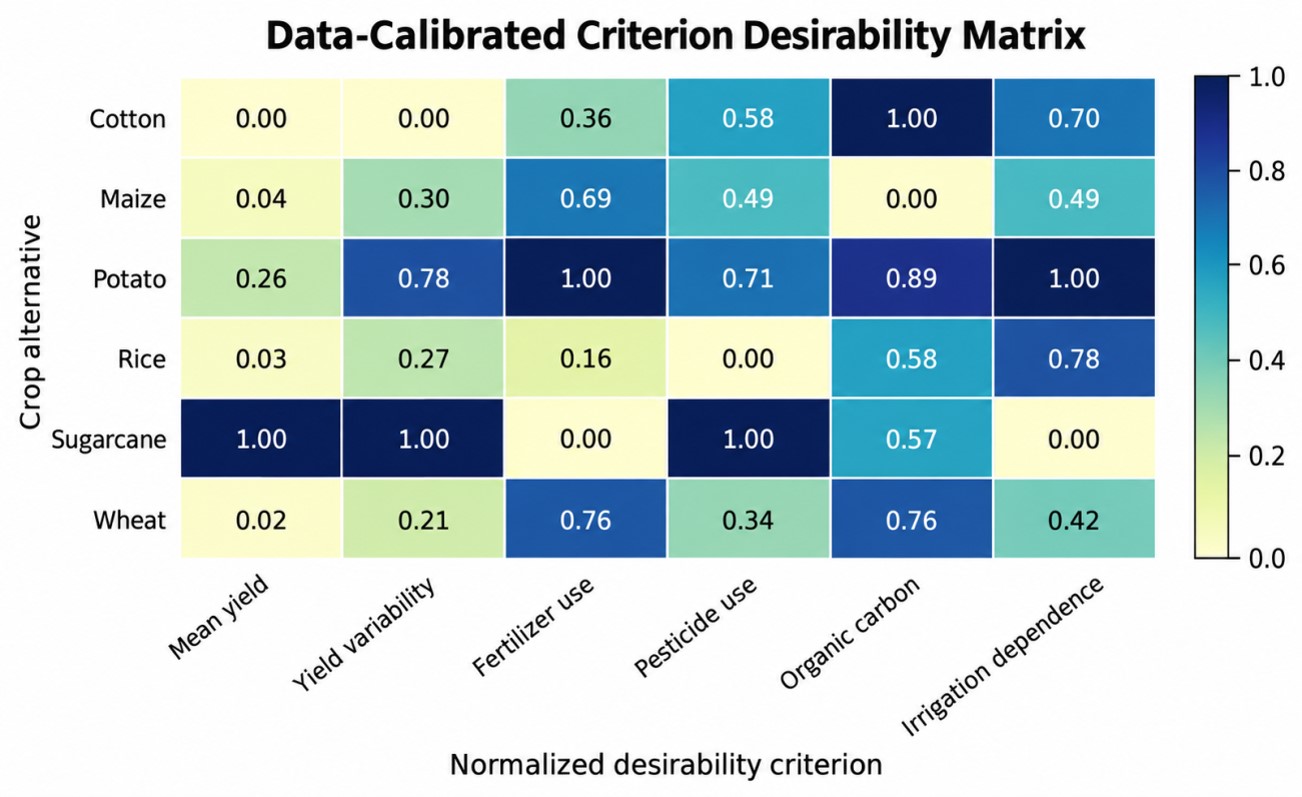
Crop prioritisation requires simultaneous evaluation of productivity, production stability, input burden, soil condition, and irrigation dependence under uncertain evidence. This study proposes a Reliability-Calibrated q-Rung Orthopair Fuzzy Distance-to-Ideal method (RC-qROF-DI) for transparent, non-predictive agricultural decision support. Unlike conventional applications that elicit membership, non-membership, and hesitation independently, RC-qROF-DI transforms observed desirability and empirical reliability into an admissible orthopair representation in which unresolved evidence is determined by data quality. The method was evaluated using 10,000 complete observations covering six crops and 20 soil, climate, management, contextual, and yield variables. Six decision criteria were constructed: mean yield, yield variability, fertilizer use, pesticide use, organic carbon, and irrigation dependence. Entropy weights were combined with q-rung orthopair distance-to-ideal ranking. At the primary Fermatean setting, sugarcane ranked first with a closeness coefficient of 0.5747, followed by potato (0.5473), wheat (0.4341), maize (0.4241), cotton (0.4195), and rice (0.4096). The first three positions were preserved across the intuitionistic, Pythagorean, Fermatean, and higher-rung specifications; full-ranking Spearman agreement with the primary model ranged from 0.9429 to 1.0000. All ±10% weight perturbations preserved the ranking. Across 500 stratified bootstrap samples, sugarcane ranked first in 86.4% and potato in 13.4%. The framework provides an auditable link from numerical evidence to fuzzy support, opposition, indeterminacy, and ranking uncertainty. Its output is a within-dataset production-profile prioritisation, not a location-specific agronomic recommendation.
References
L. Mozumdar, "Agricultural productivity and food security in the developing world," Bangladesh J. Agric. Econ., vol. 35, pp. 53–69, 2012.
M. A. Jabed and M. A. Murad, "Crop yield prediction in agriculture: A comprehensive review of machine learning and deep learning approaches, with insights for future research and sustainability," Heliyon, vol. 10, Art. no. e40836, 2024.
R. Aworka et al., "Agricultural decision system based on advanced machine learning models for yield prediction: Case of East African countries," Smart Agric. Technol., vol. 2, Art. no. 100048, 2022, doi: 10.1016/j.atech.2022.100048.
L. S. Cedric et al., "Crops yield prediction based on machine learning models: Case of West African countries," Smart Agric. Technol., vol. 2, Art. no. 100049, 2022, doi: 10.1016/j.atech.2022.100049.
M. Cheng et al., "Combining multi-indicators with machine-learning algorithms for maize yield early prediction at the county level in China," Agric. For. Meteorol., vol. 323, Art. no. 109057, 2022, doi: 10.1016/j.agrformet.2022.109057.
Z. Li, L. Ding, and D. Xu, "Exploring the potential role of environmental and multi-source satellite data in crop yield prediction across Northeast China," Sci. Total Environ., vol. 815, Art. no. 152880, 2022, doi: 10.1016/j.scitotenv.2021.152880.
S. Ju et al., "Optimal county-level crop yield prediction using MODIS-based variables and weather data," Agric. For. Meteorol., vol. 307, Art. no. 108530, 2021, doi: 10.1016/j.agrformet.2021.108530.
M. K. Senapaty, A. Ray, and N. Padhy, "A decision support system for crop recommendation using machine learning classification algorithms," Agriculture, vol. 14, no. 8, Art. no. 1256, 2024, doi: 10.3390/agriculture14081256.
C. Musanase, A. Vodacek, D. Hanyurwimfura, A. Uwitonze, and I. Kabandana, "Data-driven analysis and machine learning-based crop and fertilizer recommendation system for revolutionizing farming practices," Agriculture, vol. 13, no. 11, Art. no. 2141, 2023, doi: 10.3390/agriculture13112141.
M. M. Hasan et al., "Ensemble machine learning-based recommendation system for effective prediction of suitable agricultural crop cultivation," Front. Plant Sci., vol. 14, Art. no. 1234555, 2023, doi: 10.3389/fpls.2023.1234555.
M. S. B. Alam, V. Esichaikul, A. Lameesa, S. F. Ahmed, and A. H. Gandomi, "An approach for crop recommendation with uncertainty quantification based on machine learning for sustainable agricultural decision-making," Results Eng., vol. 26, Art. no. 105505, 2025, doi: 10.1016/j.rineng.2025.105505.
L. A. Zadeh, "Fuzzy sets," Inf. Control, vol. 8, no. 3, pp. 338–353, 1965, doi: 10.1016/S0019-9958(65)90241-X.
K. T. Atanassov, "Intuitionistic fuzzy sets," Fuzzy Sets Syst., vol. 20, no. 1, pp. 87–96, 1986, doi: 10.1016/S0165-0114(86)80034-3.
R. R. Yager, "Pythagorean membership grades in multicriteria decision making," IEEE Trans. Fuzzy Syst., vol. 22, no. 4, pp. 958–965, Aug. 2014, doi: 10.1109/TFUZZ.2013.2278989.
R. R. Yager, "Generalized orthopair fuzzy sets," IEEE Trans. Fuzzy Syst., vol. 25, no. 5, pp. 1222–1230, Oct. 2017, doi: 10.1109/TFUZZ.2016.2604005.
P. Liu and P. Wang, "Some q-rung orthopair fuzzy aggregation operators and their applications to multiple-attribute decision making," Int. J. Intell. Syst., vol. 33, no. 2, pp. 259–280, Feb. 2018, doi: 10.1002/int.21927.
G. Wei, H. Gao, and Y. Wei, "Some q-rung orthopair fuzzy Heronian mean operators in multiple attribute decision making," Int. J. Intell. Syst., vol. 33, no. 7, pp. 1426–1458, Jul. 2018, doi: 10.1002/int.21985.
P. Ejegwa, C. Nwokoro, and B. Alechenu, "A new numerical method of q-rung orthopair fuzzy distance measure for robotics selection analysis," in Fuzzy Decision-Making Algorithms: Mathematical Optimization, Metaheuristic Optimization, Supply Chain Management, K. Kumar, S. Bhat, P. Ejegwa, and R. Bhardwaj, Eds. Berlin, Germany: De Gruyter, 2026, pp. 129–146, doi: 10.1515/9783112222249-008.
P. A. Ejegwa, M. T. Anum, N. Kausar, C. O. Nwokoro, and T. A. Cagin, "A novel q-rung orthopair fuzzy distance metric for energy source selection," J. Appl. Res. Ind. Eng., Art. no. e226106, 2025.
C. Nwokoro, P. Ejegwa, G. Ataguba, and R. Orji, "Systematic review of the state-of-the-art fuzzy logic applications in agriculture: Implications for smart agriculture," in Fuzzy Decision-Making Algorithms: Mathematical Optimization, Metaheuristic Optimization, Supply Chain Management, K. Kumar, S. Bhat, P. Ejegwa, and R. Bhardwaj, Eds. Berlin, Germany: De Gruyter, 2026, pp. 191–242, doi: 10.1515/9783112222249-011.
G. Ataguba et al., "Exploring pregnancy app reviews: Implications for human-centered design," in Lecture Notes in Computer Science. Cham, Switzerland: Springer, 2026, pp. 49–68, doi: 10.1007/978-3-032-30549-7_3.
R. R. Yager and N. Alajlan, "Approximate reasoning with generalized orthopair fuzzy sets," Inf. Fusion, vol. 38, pp. 65–73, Nov. 2017.
B. Erdebilli and Ç. Sıcakyüz, "An integrated q-rung orthopair fuzzy method for the selection of supply-chain management," Sustainability, vol. 16, no. 12, Art. no. 4901, 2024, doi: 10.3390/su16124901.
M. Rahim, K. Shah, H. Alqahtani, S. A. Alhabeeb, and H. A. E.-W. Khalifa, "Adaptive multi-criteria group decision-making for optimized crop selection using the p,q-quasirung orthopair fuzzy hybrid aggregation operator," Expert Syst. Appl., vol. 286, Art. no. 128126, 2025, doi: 10.1016/j.eswa.2025.128126.