A Systematic Analysis of Subsystem Interactions and Failure Propagation in Intuitionistic Fuzzy Graphs
DOI:
https://doi.org/10.63924/jau.v2i1.346Keywords:
Intuitionistic Fuzzy Graph, Complete Intuitionistic Fuzzy Graph, Subsystem Interaction, Failure Propagation, Cascading Failure, Edge Domination, Bondage Set, System Reliability, Vulnerability AnalysisAbstract
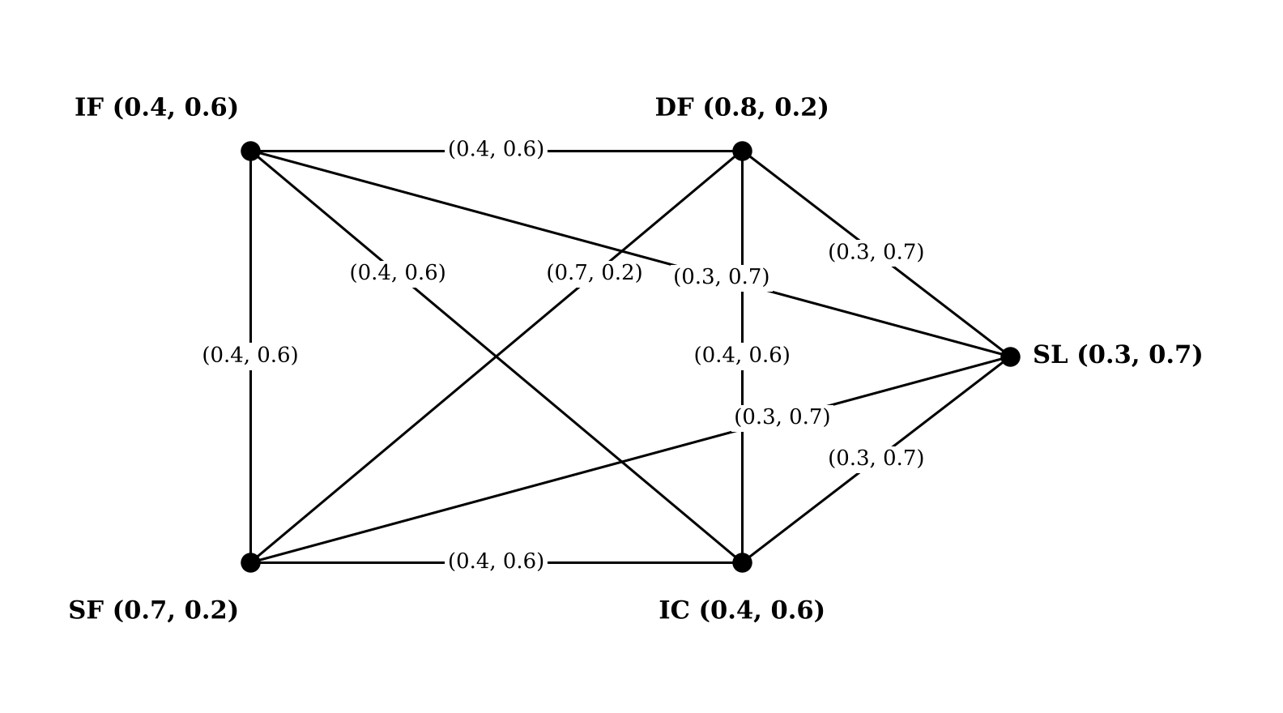
Intuitionistic fuzzy graphs (IFGs) provide a mathematical framework for modelling complex systems characterised by uncertainty, imprecise relationships and incomplete information. Unlike fuzzy graphs, IFGs attach to every vertex and edge a membership degree, a non-membership degree and a hesitation degree. This paper uses complete intuitionistic fuzzy graphs (CIFGs) to analyse how a failure that starts in one part of a system spreads to the others. Each vertex represents a stage of the failure process (a failure state), and each edge represents the interaction through which failure can pass from one stage to another. The membership degree measures how strongly failure propagates, and the non-membership degree measures how strongly it does not. We define the strength of connectedness, strong edges, edge domination and bondage sets for CIFGs, and we give a systematic algorithm for finding a minimum edge dominating set, a minimum bondage set and non-bondage sets. The method is illustrated on a five-state failure chain. In this example the edge between the detected failure and the spreading failure is the dominant propagation channel, every edge is strong, the edge domination number is 0.7, and the minimum bondage set consists of the four edges incident to the system-level failure state (total cardinality 1.2). The results give a theoretical basis for reliability assessment, risk analysis, fault diagnosis and resilient design of interconnected systems.
References
Akram, M., & Zafar, F. (2020). Hybrid soft computing models applied to graph theory. Springer.
Atanassov, K. T. (1986). Intuitionistic fuzzy sets. Fuzzy Sets and Systems, 20(1), 87–96.
Chartrand, G., Jordon, H., Vatter, V., & Zhang, P. (2024). Graphs & digraphs (7th ed.). Chapman & Hall/CRC.
Diestel, R. (2025). Graph theory (6th ed.). Springer.
Mathew, S., Mordeson, J. N., & Malik, D. S. (2018). Fuzzy graph theory. Springer.
Mordeson, J. N., Mathew, S., & Gayathri, G. (2023). Fuzzy graph theory: Applications to global problems. Springer.
Naeem, T., Gumaei, A., Jamil, M. K., Alsanad, A., & Ullah, K. (2021). Connectivity indices of intuitionistic fuzzy graphs and their applications in internet routing and transport network flow. Mathematical Problems in Engineering, 2021, Article 4156879. https://doi.org/10.1155/2021/4156879
Rashmanlou, H., & Borzooei, R. A. (2024). Intuitionistic fuzzy graphs: Theory and applications. De Gruyter.
Rosenfeld, A. (1975). Fuzzy graphs. In L. A. Zadeh, K. S. Fu, & M. Shimura (Eds.), Fuzzy sets and their applications to cognitive and decision processes (pp. 77–95). Academic Press.
Shao, Z., Kosari, S., Rashmanlou, H., & Shoaib, M. (2020). New concepts in intuitionistic fuzzy graph with application in water supplier systems. Mathematics, 8(8), 1241. https://doi.org/10.3390/math8081241
Talebi, A. A., Kacprzyk, J., Rashmanlou, H., & Sadati, S. H. (2020). A new concept of an intuitionistic fuzzy graph with applications. Journal of Multiple-Valued Logic & Soft Computing, 35(5–6), 431–450.
Talebi, A. A., & Rashmanlou, H. (2025). Advanced concepts in intuitionistic fuzzy graph theory. Springer.