Real Time Indian Sign Language Recognition System Using Mediapipe and Multi-Layer Perceptron
DOI:
https://doi.org/10.63924/jau.v2i1.328Keywords:
Indian Sign Language, Sign Language Recognition, MediaPipe, Computer Vision, Multi-Layer Perceptron, Machine Learning, Gesture RecognitionAbstract
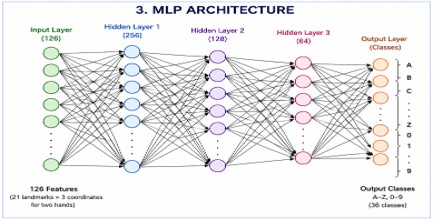
Indian Sign Language (ISL) is an essential means of communication for individuals with hearing and speech impairments. However, communication barriers still exist due to limited availability of real-time sign language recognition systems and lack of public awareness. To address these challenges, this paper presents a real time Indian Sign Language recognition system that combines computer vision and machine learning techniques to recognize ISL alphabets and numerical gestures. The proposed system utilizes MediaPipe Hands to detect and extract three-dimensional hand landmarks coordinates from live webcam input, which are then classified using a multi-layer perceptron (MLP) model. A custom dataset of ISL gestures was created, preprocessed, and used for model training and evaluation. The trained model is integrated into a web-based application that enables users to perform gesture recognition in real time without requiring any wearable devices or hardware. Experimental evaluation demonstrated that the proposed system provides efficient real time recognition under normal conditions while maintaining low computational complexity. The developed framework offers a practical, cost-effective, and user-friendly solution for supporting ISL learning and improving communication among deaf and hearing communities.
References
R. Rastgoo, B. Kiani, and S. Escalera, "Sign language recognition: A deep survey," Expert Systems with Applications, vol. 164, 2021.
A. Wadhawan and P. Kumar, "Sign language recognition systems: A decade systematic literature review," Archives of Computational Methods in Engineering, 2021.
I. A. Adeyanju et al., "Machine learning methods for sign language recognition: a critical review and analysis," Intelligent Systems with Applications, 2021.
S. Ghotkar et al., "Hand gesture recognition for indian sign language," International Journal of Computer Applications, 2012.
A. Tyagi et al., "Vision-based indian sign language recognition using machine learning," Procedia Computer Science, 2020.
I. Goodfellow, Y. Bengio, and A. Courville, Deep Learning. MIT Press, 2016.
C. Lugaresi, J. Tang, H. Nash et al., "Mediapipe: A framework for building perception pipelines," arXiv preprint arXiv:1906.08172, 2019.
G. Bradski, "The opencv library," in Dr. Dobb's Journal of Software Tools, 2000.
V. Nair and G. E. Hinton, "Rectified linear units improve restricted boltzmann machines," Proceedings of ICML, 2010.
N. Srivastava, G. Hinton, A. Krizhevsky, I. Sutskever, and R. Salakhutdinov, "Dropout: A simple way to prevent neural networks from overfitting," Journal of Machine Learning Research, vol. 15, pp. 1929–1958, 2014.
D. P. Kingma and J. Ba, "Adam: A method for stochastic optimization," International Conference on Learning Representations, 2015.
Downloads
Published
How to Cite
Issue
Section
Most read articles by the same author(s)
- Binod Kumar Sharma, Apostolos Syropoulos, Erdős–Rényi Models and Neutrosophic Sets , Journal of Analytical Uncertainty: Vol. 1 No. 2 (2026): JAU: June 2026
- Binod Kumar Sharma, Apostolos Syropoulos, DFA Minimization of Fuzzy Multiset Automata , Journal of Analytical Uncertainty: Vol. 2 No. 1 (2026): JAU: December 2026