Designing Bayesian Skip-Lot Sampling Plan V (Sksp–V) for Clinical Trial Monitoring
DOI:
https://doi.org/10.63924/jau.v1i2.291Keywords:
Bayesian sampling plan, Skip-lot design, Clinical trial monitoring, Adaptive design, Operating characteristic curve, AOQLAbstract
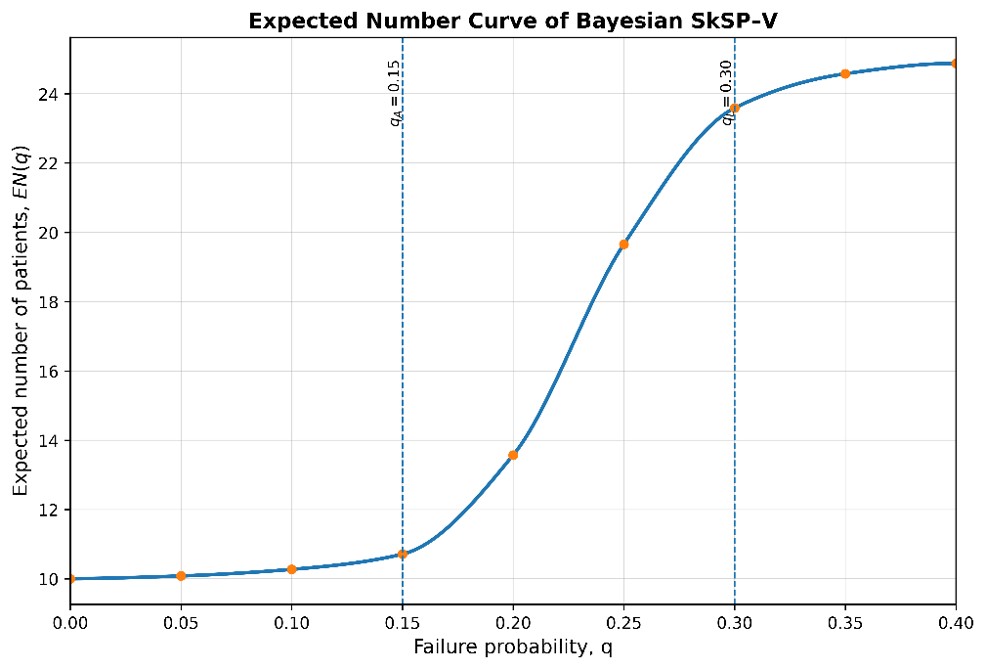
This study develops a Bayesian extension of the Skip-Lot Sampling Plan V (SkSP V) and demonstrates its utility in adaptive clinical trial monitoring. The proposed approach incorporates prior information, probabilistic decision rules, and a skipping mechanism to minimize patient exposure while preserving statistical efficiency. Methodologically, the plan defines operating characteristic (OC) curves, average outgoing quality (AOQ), average outgoing quality limit (AOQL), and expected sample number (EN) under a Bayesian framework. A case study in a Phase II clinical trial context illustrates the adaptability of SkSP V to real-world monitoring, where patient cohorts are treated as lots and treatment failures as defectives. Simulation results show that Bayesian SkSP V achieves higher acceptance probability at acceptable efficacy levels while maintaining strong protection against poor treatments at limiting efficacy levels. Compared with alternative skip-lot designs such as SkSP III, the Bayesian SkSP V achieves a lower AOQL and reduced expected sample number, thereby offering both ethical and statistical advantages. These findings suggest that Bayesian SkSP V provides a robust, efficient, and ethically favorable framework for modern clinical research, bridging the gap between industrial quality control methods and biomedical trial monitoring.
References
H. F. Dodge, "Skip-lot sampling plan," Industrial Quality Control, vol. 15, no. 6, pp. 5–8, 1959.
M. Sobel and J. A. Tischendrof, "Acceptance sampling with new life test objectives," Pro- ceedings of the Fifth National Symposium on Reliability and Quality Control, Philadelphia, pp. 108–118, 1962.
K. Govindaraju and R. Subramani, "A note on skip-lot sampling plan," Journal of Applied Statistics, vol. 27, no. 3, pp. 389–398, 2000.
M. Aslam, "Skip-lot sampling plan using resubmitted lots," Communications in Statistics: Simulation and Computation, vol. 37, no. 6, pp. 1183–1191, 2008.
C. W. Wu and S. H. Chou, "Design of skip-lot sampling plans with Bayesian approaches," Journal of Statistical Planning and Inference, vol. 142, no. 11, pp. 2997–3006, 2012.
M. Aslam and C. H. Jun, "Skip-lot sampling plans with the Weibull distribution," Journal of Applied Statistics, vol. 42, no. 5, pp. 1093–1104, 2015.
R. Ramkumar and P. Vijayaraghavan, "Modified skip-lot sampling plan based on Bayesian decision theory," Quality Technology & Quantitative Management, vol. 15, no. 2, pp. 208–223, 2018.
M. Aslam, "Designing skip-lot sampling plans using lifetime distributions under uncertainty," Mathematics, vol. 8, no. 9, p. 1532, 2020. doi:10.3390/math8091532.
U.S. Food and Drug Administration, "Adaptive designs for clinical trials of drugs and biologics," FDA Guidance for Industry, 2020. Available: https://www.fda.gov.
J. Wason, L. Trippa, and L. Bacci, "Bayesian adaptive designs for clinical trials," Statistics in Medicine, vol. 40, no. 2, pp. 465–484, 2021.
U.S. Food and Drug Administration, "Bayesian statistics for medical device clinical trials," FDA Guidance Document, 2022. Available: https://www.fda.gov.
J. Lee and H. Kim, "Recent advances in Bayesian adaptive designs in clinical research," Contemporary Clinical Trials, vol. 123, p. 107040, 2023.
X. Wang and Y. Chen, "Efficient Bayesian monitoring methods for clinical trial quality,"Journal of Biopharmaceutical Statistics, vol. 34, no. 1, pp. 88–105, 2024.